Trusted by Industry Leaders

Strategic Tender Writing and Bid Advisory Services Australia

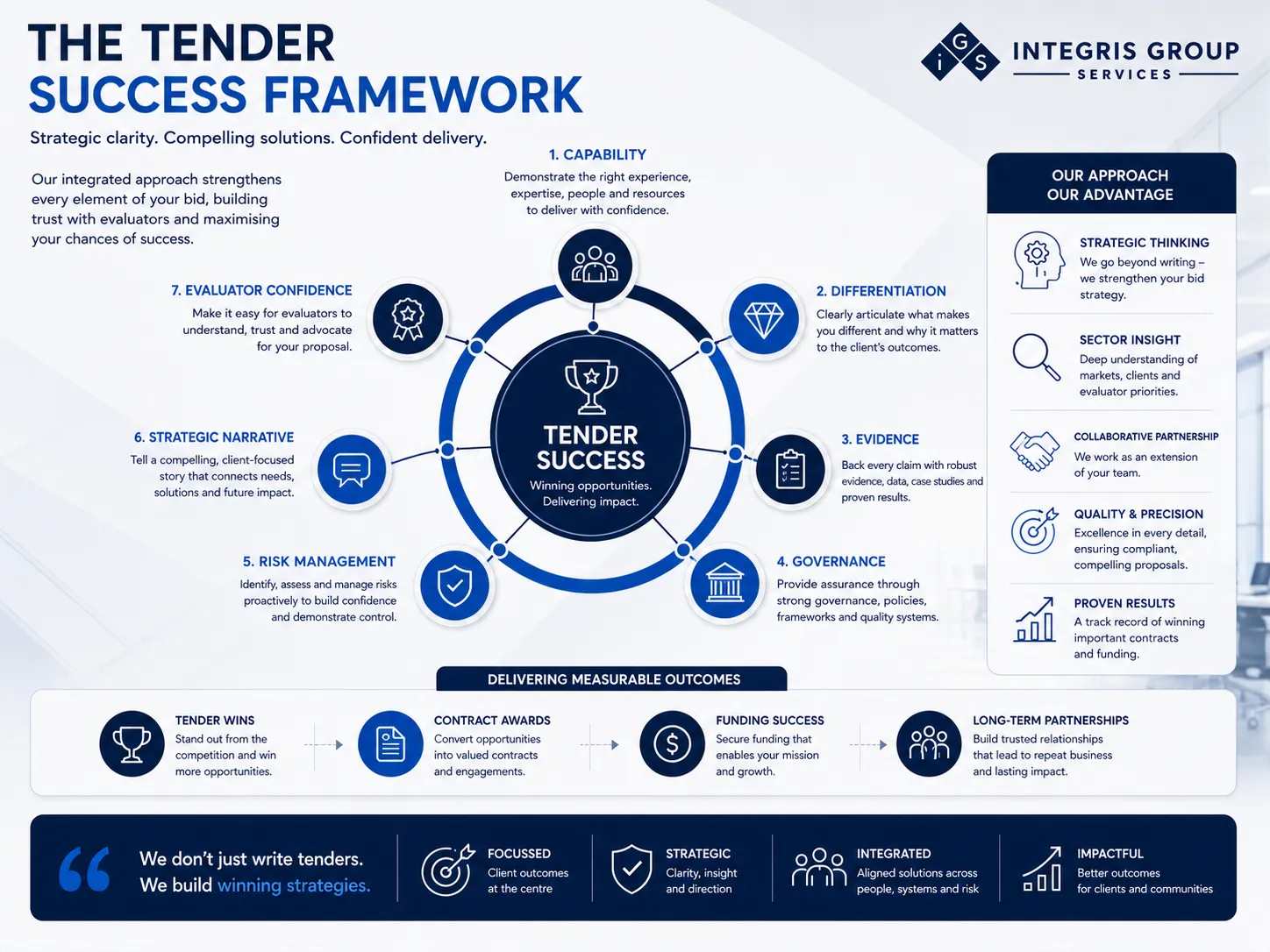
Winning a tender is rarely about completing a response document. In highly competitive procurement environments, successful organisations are those that can clearly articulate their capability, demonstrate credibility, manage evaluator risk, and communicate why they represent the best value proposition.

At Integris Group Services, we help organisations move beyond compliance-driven responses and develop compelling tender submissions that align organisational strengths with evaluator expectations. Our approach combines strategic thinking, operational understanding, technical writing expertise, and procurement insight to strengthen every stage of the response process.

Whether responding to government tenders, panel opportunities, Requests for Proposal (RFPs), Requests for Tender (RFTs), Requests for Information (RFIs), or Requests for Quotation (RFQs), we work with organisations to identify differentiators, strengthen capability statements, articulate value, and present evidence that builds confidence with evaluators.

Our services extend beyond writing. We support bid strategy, content development, review and challenge processes, governance reviews, and submission readiness. The result is a tender response that is not only compliant, but also strategically positioned to maximise competitiveness and improve win rates.
Strategic Tender Writing and Bid Advisory Services Australia

Winning More Than Compliance: Strategic Tendering Insights for Australian Organisations

Our core competencies
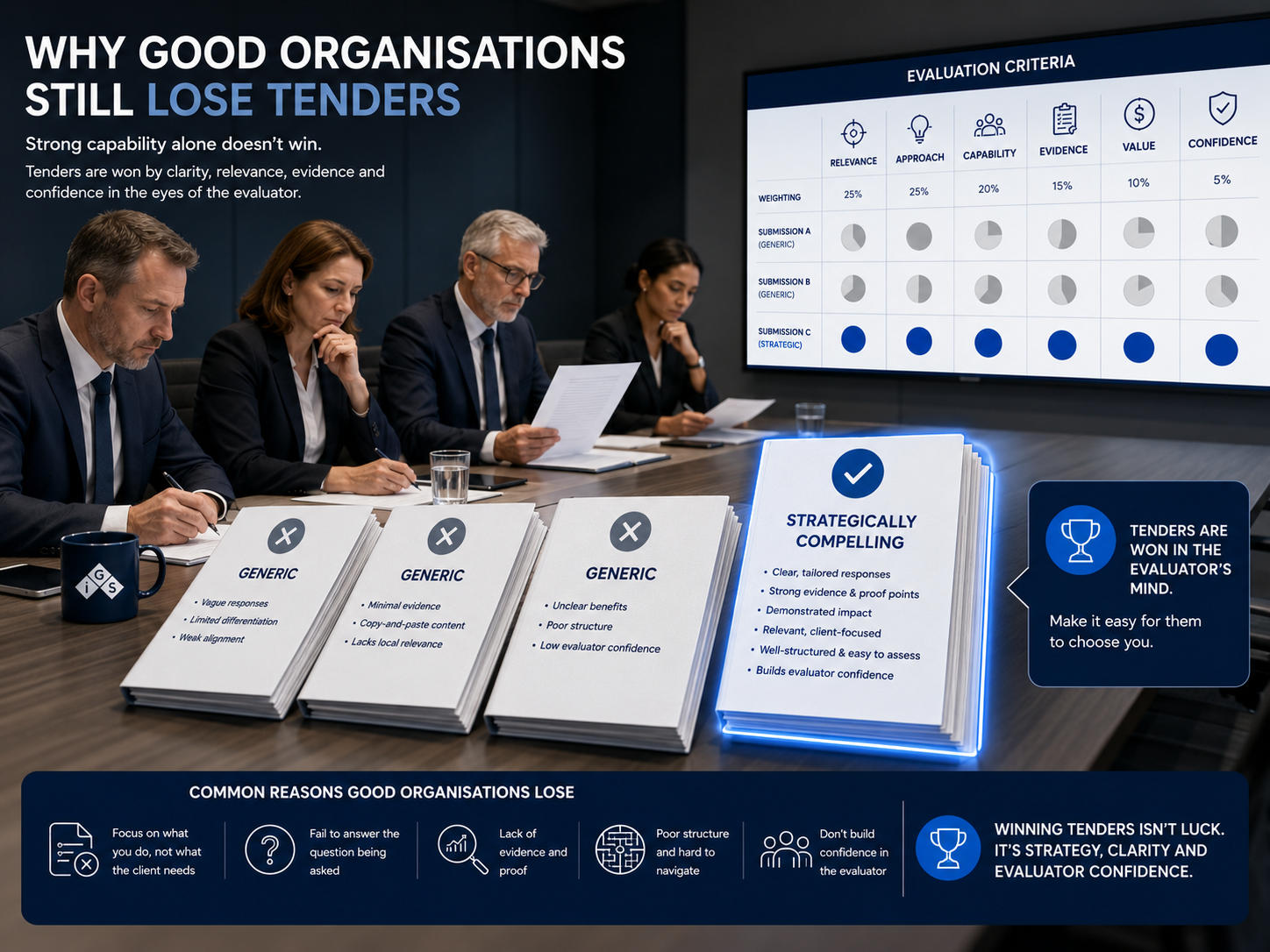
Why Good Organisations Still Lose Tenders
Why Good Organisations Still Lose Tenders

Many organisations assume that if they have the capability to deliver a project successfully, they will naturally perform well in a competitive tender process. Unfortunately, procurement outcomes rarely work that way. Across government, infrastructure, not-for-profit, defence, professional services, and regulated industries, organisations with strong track records regularly lose opportunities to competitors with similar—or sometimes lesser—capability. The reason is often not delivery experience, technical expertise, or organisational capacity. It is the inability to effectively communicate those strengths within the tender response itself. Tender evaluation is ultimately a decision-making process. Evaluators are tasked with reviewing multiple submissions, assessing evidence, managing risk, and selecting a supplier that provides confidence in delivery. They are not simply comparing capabilities. They are comparing how those capabilities are presented, evidenced, and aligned to the objectives of the procurement. Many organisations unintentionally assume evaluators already understand the value they bring. Internal teams often possess deep institutional knowledge of their services, experience, and differentiators, leading them to provide responses that feel obvious from an internal perspective. However, evaluators only have access to the information presented in the submission. This creates a common challenge. An organisation may have delivered dozens of successful projects, possess highly experienced personnel, and maintain strong governance systems, yet fail to clearly articulate why those strengths matter to the evaluator. Successful tendering requires organisations to shift their perspective. Rather than asking "What do we want to say?", organisations should ask "What does the evaluator need to understand in order to confidently select us?" This means focusing on evidence rather than assertions, outcomes rather than activities, benefits rather than features, and evaluator priorities rather than internal assumptions. Organisations that consistently adopt this approach are often better positioned to demonstrate value, reduce perceived risk, and strengthen evaluator confidence. Strong tender responses build confidence. They demonstrate not only capability but also credibility, risk management, governance maturity, and a clear understanding of the client's objectives. Effective submissions often draw upon broader organisational strengths such as Governance and Sustainability Advisory, Compliance Management, and structured operational frameworks that support successful delivery. At Integris Group Services, we frequently observe that winning tenders is less about having the best story and more about presenting the strongest evidence in a way that aligns with evaluator expectations. Organisations that understand this distinction significantly improve their competitiveness, regardless of size or sector. Ultimately, good organisations lose tenders when they assume capability speaks for itself. Great organisations understand that capability must be translated into a compelling and credible value proposition that resonates with evaluators and reduces perceived risk.
Learn More →
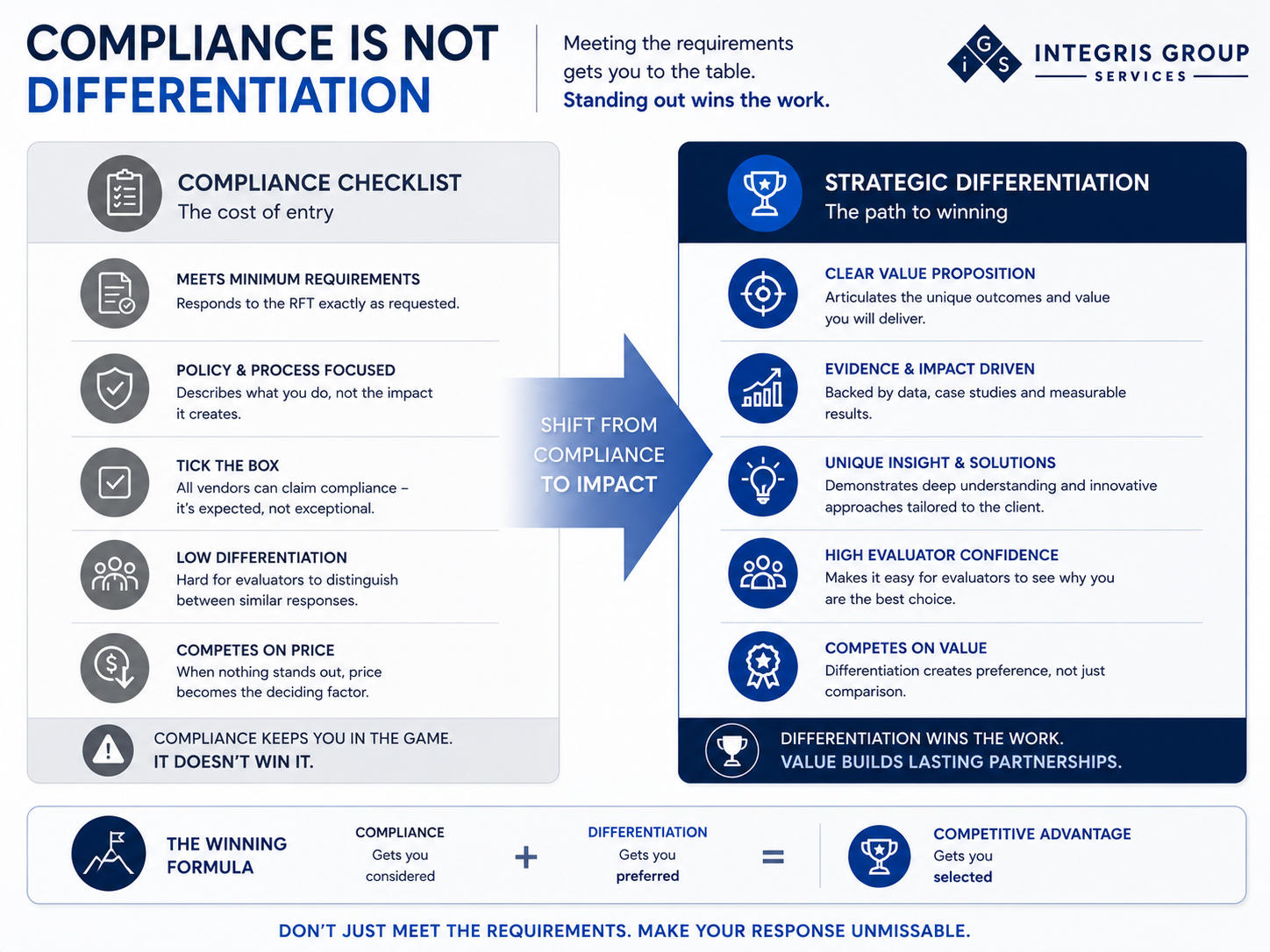
Compliance Is Not Differentiation

Compliance Is Not Differentiation

One of the most common misconceptions in tendering is the belief that compliance creates competitive advantage. Compliance is important. Every tender response must satisfy mandatory requirements, address evaluation criteria, and provide the requested information. Without compliance, organisations risk disqualification before their submission is even fully assessed. However, compliance alone rarely wins contracts. In many procurement processes, every shortlisted organisation is capable of meeting the minimum requirements. Most respondents have the required qualifications, insurances, policies, certifications, systems, and technical expertise. If compliance is all that matters, every compliant submission would receive the same score. The reality is that evaluators are looking beyond compliance. They are seeking evidence of value, confidence in delivery, and reasons to prefer one supplier over another. This is where differentiation becomes critical. Differentiation is not about making exaggerated claims or creating marketing slogans. It is about clearly demonstrating what makes an organisation uniquely positioned to deliver the required outcomes. This may involve showcasing unique delivery methodologies, specialised industry experience, innovative approaches, stronger governance structures, proven performance outcomes, workforce capability, local knowledge, risk management expertise, or demonstrated customer success. Unfortunately, many organisations devote the majority of their effort to achieving compliance while spending very little time articulating their differentiators. This often results in submissions that are technically correct but strategically weak. Evaluators may read dozens of responses containing similar statements about quality, safety, collaboration, customer service, and innovation. Without meaningful evidence, these claims become difficult to distinguish. Strong supporting evidence is often strengthened through clear documentation, effective communication, and well-structured submissions supported by Business and Technical Content Writing. Strong organisations recognise that compliance simply earns the right to be evaluated. Differentiation is what creates separation from competitors. A useful way to think about tendering is that compliance answers the question, "Can you do the work?" Differentiation answers the far more important question, "Why should we choose you?" Organisations that consistently win tenders understand this distinction and structure their responses accordingly. They ensure every section not only addresses the requirement but also reinforces their unique value proposition and strengthens evaluator confidence. Strong differentiation is often underpinned by mature organisational systems, effective Compliance Management, sound governance practices, and a clear understanding of client priorities. The most successful tender responses therefore balance both elements: rigorous compliance and strategic differentiation.
Learn More →
Understanding How Evaluators Think

Understanding How Evaluators Think

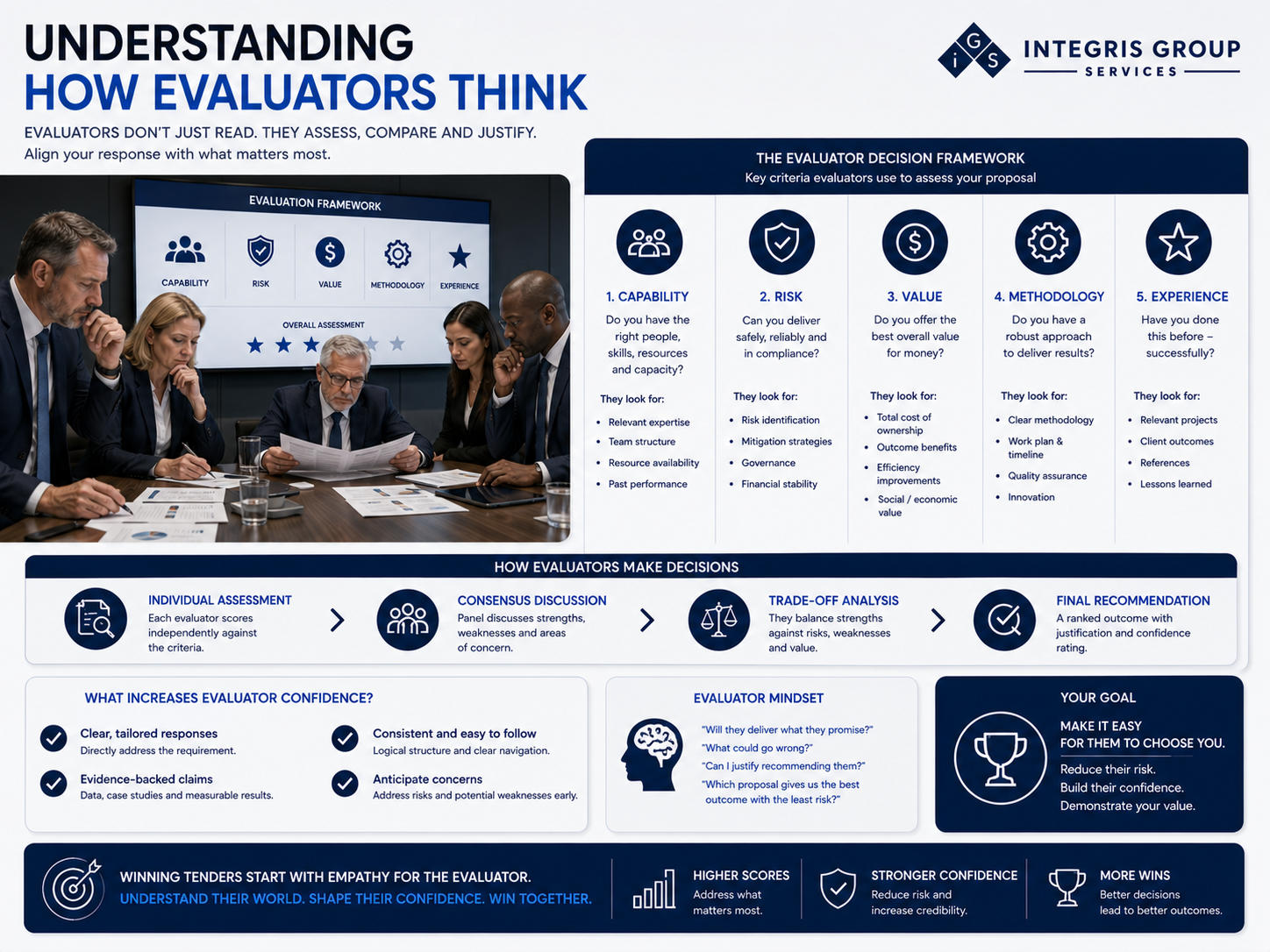
Many tender responses fail because organisations focus entirely on their own perspective rather than the perspective of the evaluator. Understanding how evaluators think is one of the most valuable skills in tender writing and bid strategy. It allows organisations to structure responses that align with procurement objectives rather than simply providing information. While every procurement process differs, evaluators are generally attempting to determine whether an organisation can deliver the required outcomes, operate safely, manage risk effectively, provide value for money, perform consistently, and be trusted to meet the client's objectives. These questions shape the entire evaluation process and influence how submissions are assessed. Importantly, evaluators are not rewarded for selecting the most creative response. They are rewarded for selecting the organisation most likely to achieve a successful outcome. This means tender evaluation is often heavily influenced by risk. Evaluators are constantly assessing delivery risk, financial risk, operational risk, governance risk, reputational risk, and implementation risk. Every section of a tender response either reduces or increases perceived risk. For example, vague statements and unsupported claims create uncertainty. In contrast, clear methodologies, measurable outcomes, relevant case studies, and demonstrated experience increase confidence. Strong organisational systems supported by effective Compliance Management and sound governance practices can further strengthen evaluator confidence by demonstrating maturity and accountability. This is why evidence plays such an important role in procurement. Evidence provides assurance that an organisation can perform as promised. It allows evaluators to move beyond aspiration and assess demonstrated capability. Organisations that understand evaluator psychology focus on building confidence throughout their response. They do not assume trust. Instead, they actively earn it through clear writing, structured responses, relevant examples, realistic methodologies, strong governance arrangements, and transparent communication. High-quality supporting documentation developed through Business and Technical Content Writing can also help ensure complex information is communicated clearly and persuasively. They also recognise that evaluators often review large volumes of information under significant time constraints. Responses that are easy to navigate, concise, and directly aligned to evaluation criteria create a more positive assessment experience. Ultimately, successful tendering is not simply about describing capability. It is about helping evaluators reach a confident decision. The organisations that consistently succeed are those that understand procurement from the evaluator's perspective and build submissions designed to answer the questions evaluators are already asking. By combining strong evidence, effective communication, robust governance, and strategic positioning, organisations can significantly improve their competitiveness in complex procurement environments.
Learn More →
The Role of Storytelling in Tender Success
The Role of Storytelling in Tender Success

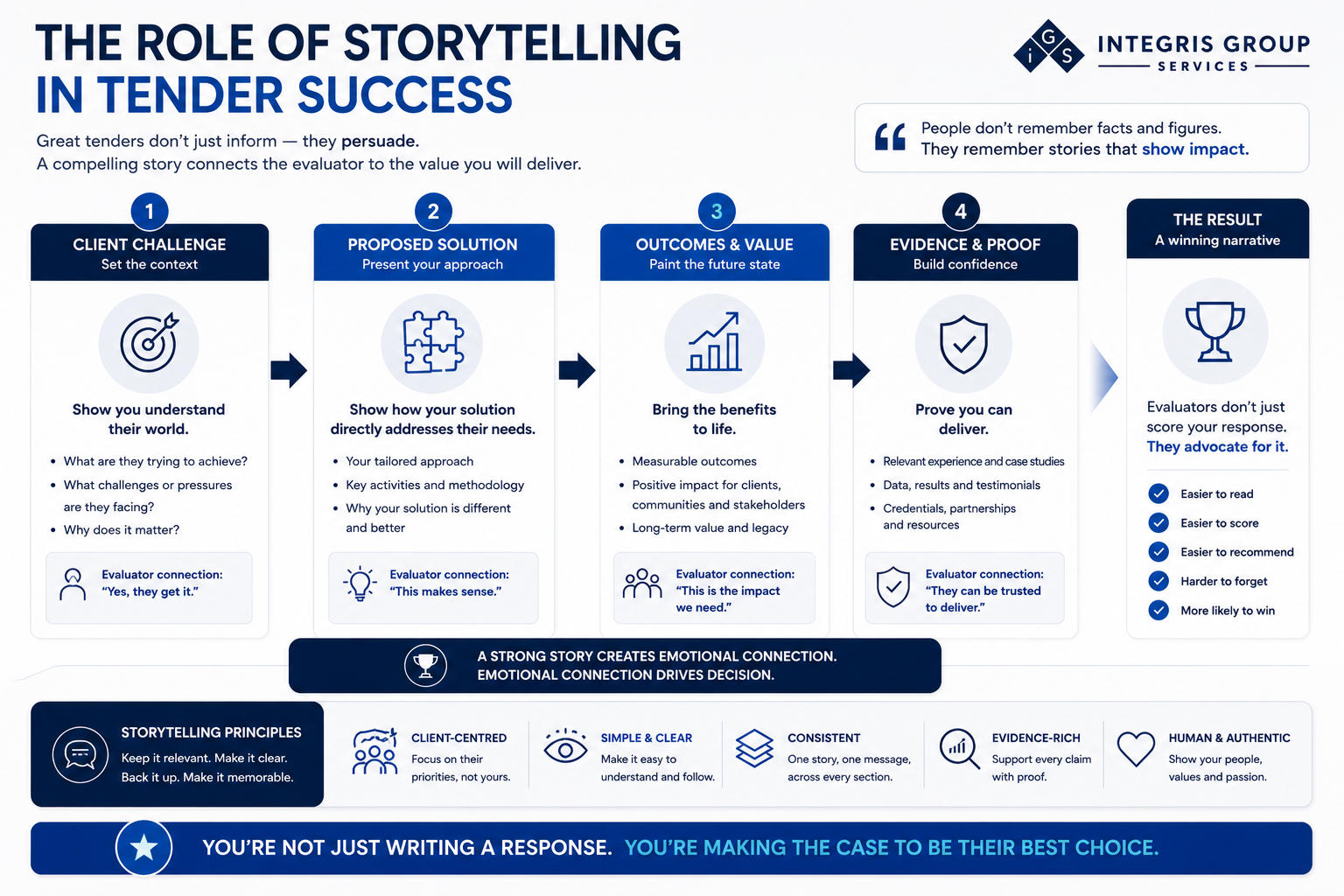
The word "storytelling" is often associated with marketing campaigns, brand development, or consumer advertising. Yet some of the most successful tender responses use storytelling principles to communicate capability, credibility, and value in a way that resonates with evaluators. This does not mean turning a tender submission into a marketing brochure. Rather, it means creating a clear narrative that helps evaluators understand the client's challenge, the organisation's approach, the evidence supporting that approach, and the outcomes that can reasonably be expected. Many tender responses fail because they present information as a collection of disconnected statements. Individual sections may satisfy compliance requirements, but they do not work together to create a coherent picture of how the organisation will deliver success. Effective storytelling solves this problem. A strong tender narrative creates logical connections between organisational experience, technical capability, delivery methodology, governance arrangements, risk management processes, and expected outcomes. The evaluator can see not only what the organisation does but why its approach is likely to succeed. This is particularly important in competitive markets where multiple respondents possess similar technical capabilities. When capability becomes comparable, narrative becomes a differentiator. Consider two organisations with similar experience. The first provides a list of projects, qualifications, and services. The second demonstrates how previous experience shaped its methodology, how that methodology addresses the client's specific challenges, and how its governance framework supports successful delivery. Both organisations may have equivalent capability. However, one provides significantly greater confidence because it tells a coherent and evidence-based story. The strongest tender narratives are also grounded in evidence. They use case studies, measurable outcomes, performance data, client testimonials, lessons learned, and practical examples to support claims and demonstrate credibility. Developing this type of compelling evidence base often requires strong Business and Technical Content Writing capabilities to ensure complex information is presented clearly and persuasively. Importantly, storytelling in tendering should never be confused with exaggeration. Evaluators are highly experienced at identifying unsupported claims and generic marketing language. Authenticity and evidence remain critical. Strong governance arrangements, supported by effective Governance and Sustainability Advisory practices and sound Compliance Management frameworks, often strengthen the credibility of an organisation's narrative by demonstrating maturity, accountability, and delivery confidence. At its best, strategic storytelling helps evaluators connect organisational capability with procurement objectives. It transforms a response from a compliance document into a compelling business case for selection. Organisations that master this approach are often able to differentiate themselves more effectively, build stronger evaluator confidence, and improve their overall success rate in competitive procurement environments. Successful storytelling is not about creative writing. It is about helping evaluators understand why an organisation is uniquely positioned to deliver the required outcomes and reduce the risks associated with procurement decisions.
Learn More →
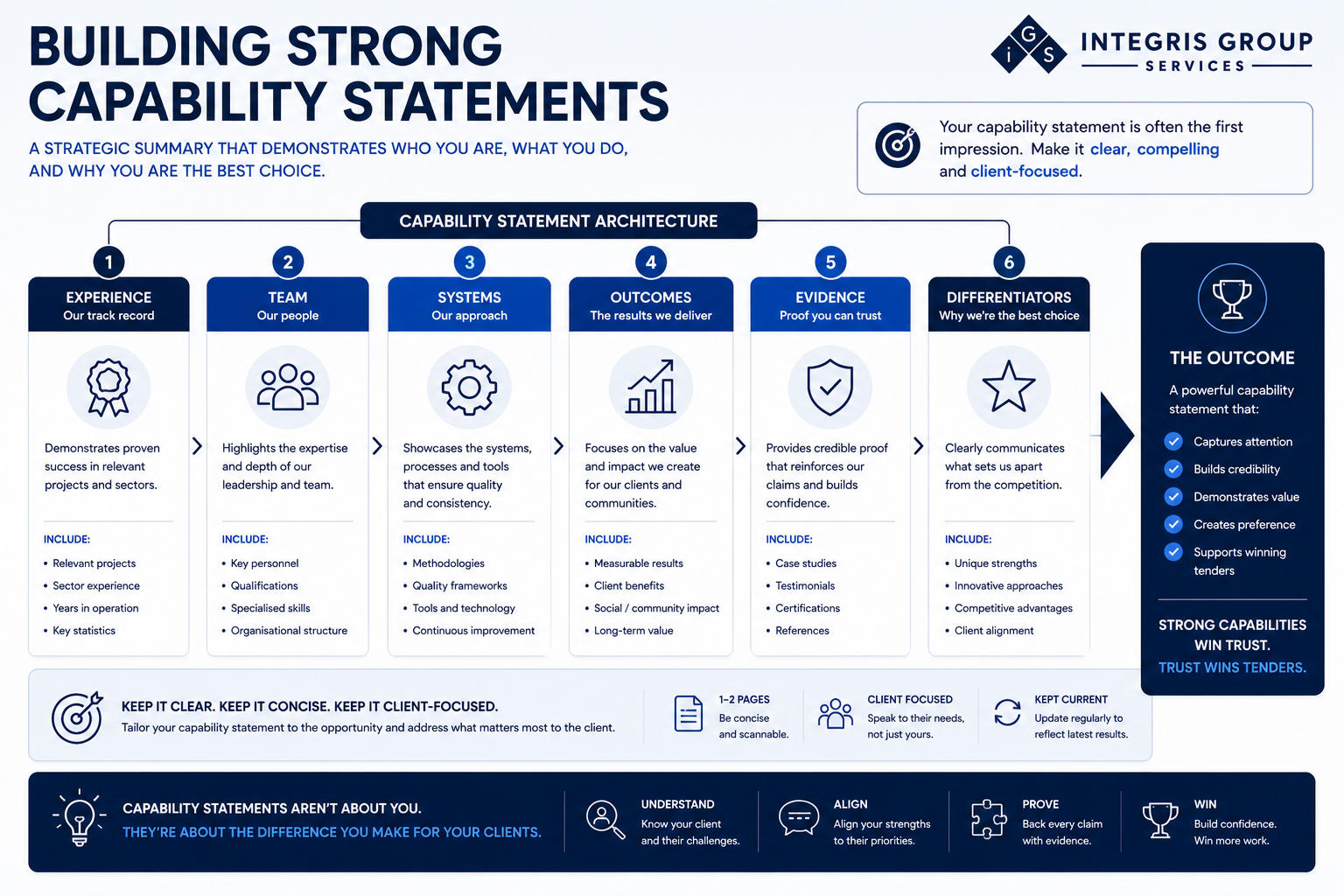
Building Strong Capability Statements
Building Strong Capability Statements

Many organisations only think about capability statements when a Tender Writing Services opportunity arises. Unfortunately, this often leads to rushed documents that focus on generic company information rather than demonstrating why the organisation should be trusted to deliver. A capability statement is far more than a company profile. It is one of the most important business development and procurement tools an organisation can possess. Whether supporting a tender submission, government procurement opportunity, panel application, partnership discussion, Funding and Grant Application Services, or direct client engagement, a well-developed capability statement creates confidence and credibility. At its core, a capability statement should answer a simple question: Why should someone choose your organisation over the alternatives? Many capability statements fail because they become overly focused on describing services rather than demonstrating outcomes. They list offerings, qualifications, certifications, and technical capabilities but provide little evidence of impact. Strong capability statements focus on clearly articulating organisational strengths, proven experience, relevant project outcomes, key personnel, governance capability, quality systems, risk management approaches, and differentiators. Importantly, they are written from the reader's perspective rather than the organisation's perspective. Procurement teams, clients, and funding bodies are ultimately assessing confidence. They want to understand whether the organisation has the capability, experience, systems, and Governance and Sustainability Advisory arrangements necessary to achieve the desired outcome. Capability statements should therefore be supported by evidence wherever possible. This may include project summaries, performance metrics, client testimonials, case studies, certifications, industry accreditations, and examples of successful delivery. Evidence helps move the conversation beyond claims and provides confidence that the organisation can achieve the outcomes it describes. Developing effective capability statements often requires a combination of clear messaging, strong structure, and professional documentation. Organisations frequently use Business and Technical Content Writing, Technical Writing Services, and Content Writing Services to ensure capability information is communicated clearly and consistently. Organisations that maintain current capability statements are also significantly better positioned when opportunities emerge. Rather than starting from scratch, they can quickly adapt and tailor content to suit specific procurement requirements while supporting broader Strategic and Operational Consulting and business growth objectives. For organisations operating in highly regulated environments, capability statements can also demonstrate effective Compliance Management, governance maturity, and risk management practices that help build evaluator confidence. Through our Business and Technical Content Writing services, Integris Group Services helps organisations develop capability statements that support tendering, business development, funding applications, and strategic growth initiatives. The strongest capability statements do not simply describe an organisation. They demonstrate why the organisation can be trusted to deliver.
Learn More →
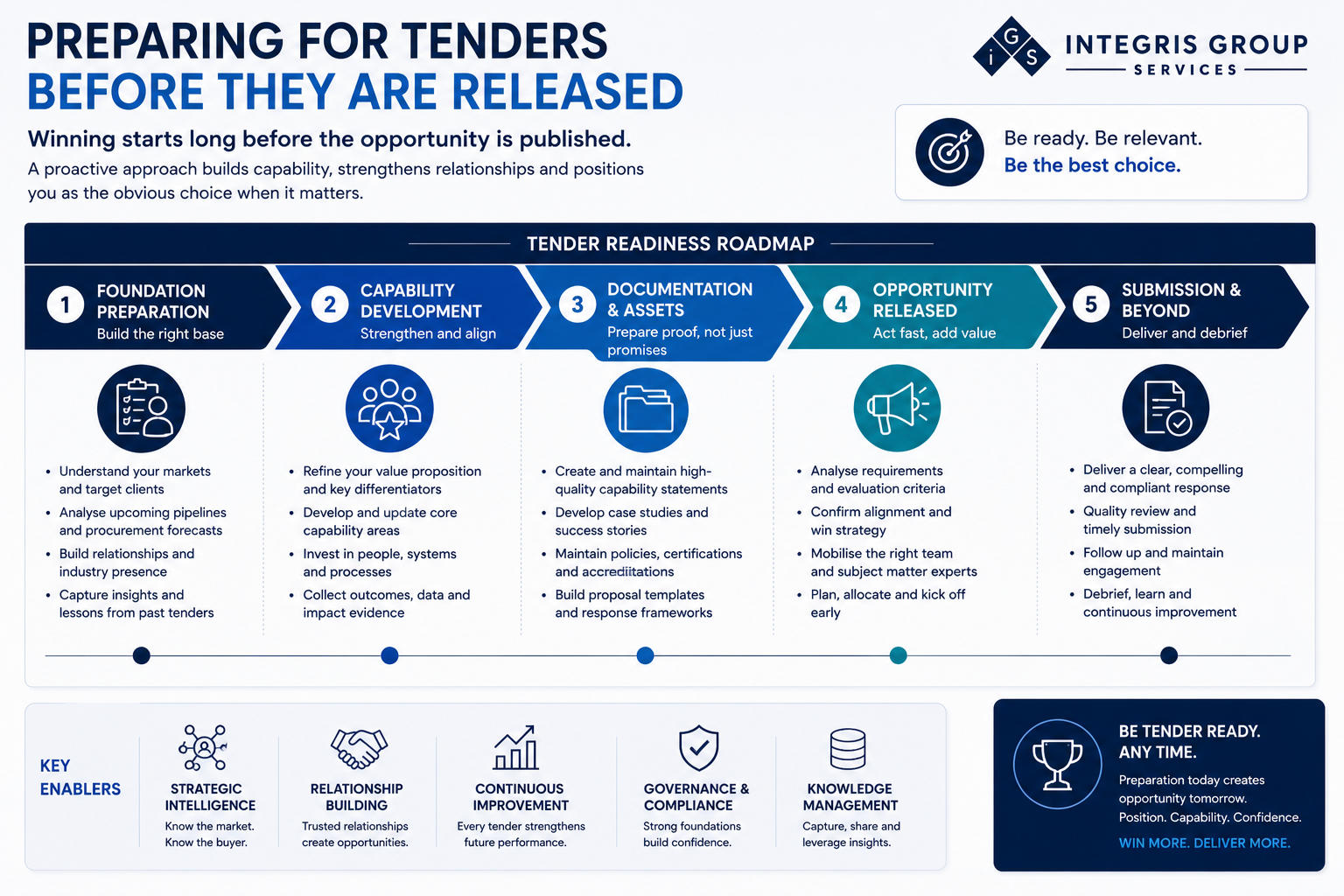
Preparing for Tenders Before They Are Released
Preparing for Tenders Before They Are Released

Many organisations begin preparing their tender response only after a procurement opportunity has been advertised. In reality, the most successful Tender Writing Services outcomes often begin months—or even years—before a tender is released. Winning organisations understand that tender success is heavily influenced by preparation. When an opportunity emerges, they already have the systems, documentation, evidence, and organisational capability necessary to respond effectively. This proactive approach is commonly referred to as tender readiness. Tender readiness involves ensuring that critical organisational assets are established and maintained before opportunities arise. These assets commonly include capability statements, case studies, project references, policies and procedures, governance documentation, quality systems, organisational charts, CVs and personnel profiles, certifications, and evidence of previous performance. Without these resources, organisations often find themselves scrambling to assemble information under significant time pressure. This can result in inconsistent responses, missed opportunities, and avoidable Compliance Management issues. Tender readiness also extends beyond documentation. Successful organisations actively develop client relationships, industry visibility, market awareness, strategic partnerships, subject matter expertise, and internal response capability. These activities strengthen competitiveness long before procurement begins and help position organisations more effectively when opportunities emerge. Government and corporate procurement processes increasingly favour organisations that demonstrate maturity, governance, and preparedness. Evidence of strong systems and organisational capability often contributes significantly to evaluator confidence. Developing and maintaining these assets often requires structured documentation and clear communication. Many organisations utilise Business and Technical Content Writing, Technical Writing Services, and Content Writing Services to ensure critical organisational information is accurate, consistent, and procurement-ready. Organisations that invest in preparation are therefore able to focus their efforts on strategy, differentiation, and value rather than basic document collection. This preparation is often supported by broader Strategic and Operational Consulting and Governance and Sustainability Advisory initiatives that strengthen organisational capability and procurement readiness. Larger organisations managing multiple projects and bid streams may also benefit from PMO Consulting Services to improve project governance, resource allocation, and delivery oversight. At Integris Group Services, we frequently support organisations through tender readiness reviews, helping identify gaps before opportunities arise and strengthening overall competitiveness. The best time to prepare for a tender is before it exists.
Learn More →
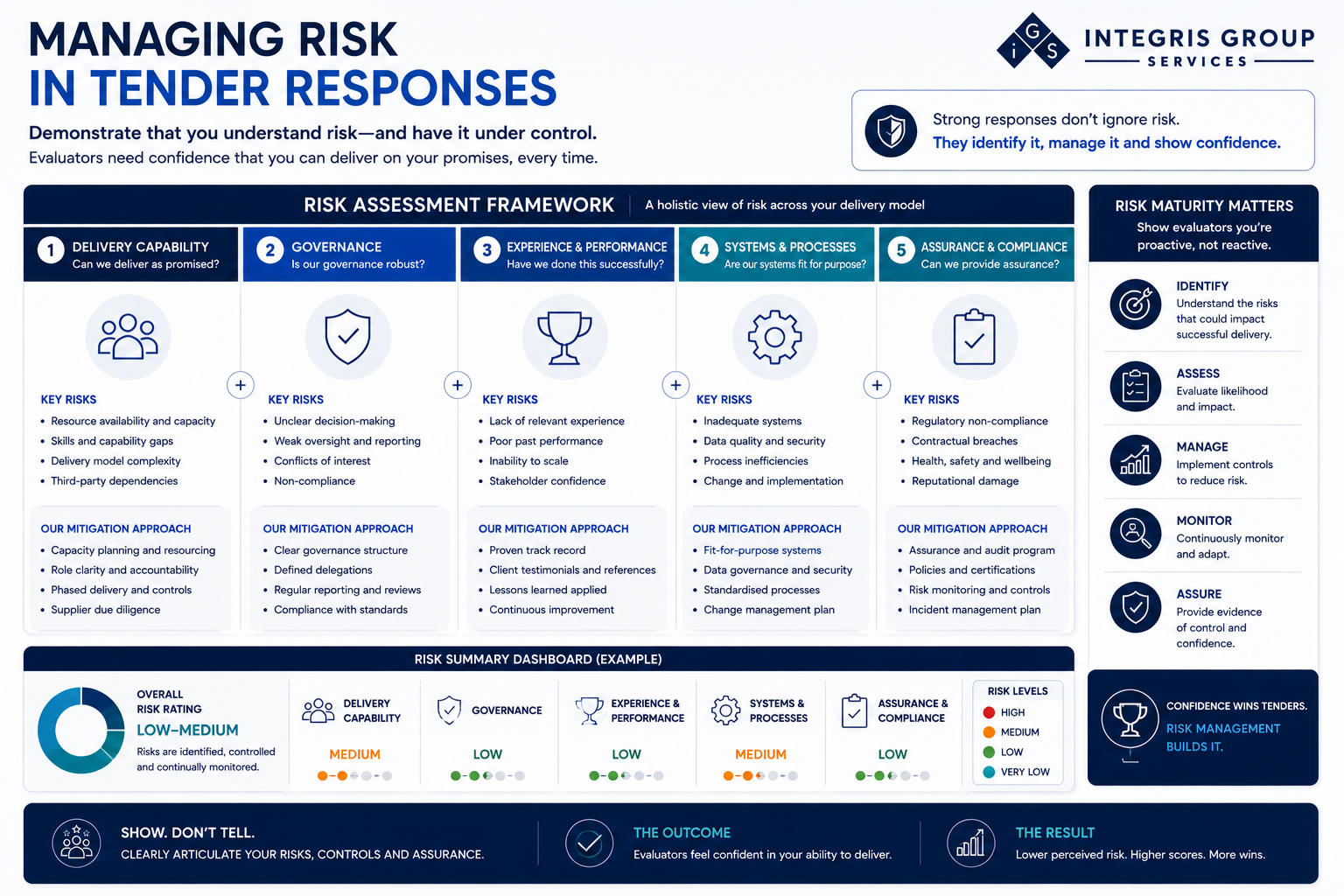
Managing Risk in Tender Responses

Managing Risk in Tender Responses

While many organisations focus on demonstrating capability during the tender process, experienced evaluators are often assessing something equally important: risk. Every procurement decision carries consequences. Selecting the wrong supplier can result in cost overruns, delivery delays, reputational damage, safety incidents, regulatory issues, or project failure. As a result, procurement teams spend considerable effort evaluating risk. This means Tender Writing Services should not simply explain what an organisation intends to do. They should demonstrate why the organisation represents a low-risk delivery partner. Risk management can be communicated through multiple aspects of a submission, including governance frameworks, project methodologies, quality systems, workforce capability, reporting structures, performance monitoring, stakeholder management practices, and evidence of previous delivery outcomes. Together, these elements help evaluators assess whether an organisation has the systems and capability necessary to manage challenges and deliver successfully. Evaluators are often seeking reassurance that risks have been identified, controls are in place, issues will be managed appropriately, and the organisation can respond effectively when challenges emerge. This is particularly important in regulated environments where Compliance Management obligations, safety requirements, and stakeholder expectations are significant. Strong responses provide evidence rather than promises. Case studies, performance data, lessons learned, and examples of risk mitigation can all help strengthen evaluator confidence. Well-structured evidence is often supported through professional Business and Technical Content Writing and Technical Writing Services that clearly communicate organisational capability. Organisations that effectively communicate risk management capability often gain a competitive advantage because they reduce uncertainty for decision-makers. This is where broader organisational maturity becomes relevant. Strong governance structures, quality systems, project management frameworks, and operational controls all contribute to a more compelling risk profile. These capabilities are often strengthened through Governance and Sustainability Advisory, PMO Consulting Services, and broader Strategic and Operational Consulting initiatives. For organisations operating across multiple contracts, projects, and regulatory environments, consistent documentation supported by Content Writing Services can also help ensure risk controls, procedures, and governance requirements are communicated effectively. Ultimately, evaluators are not simply selecting capability. They are selecting confidence. Organisations that can clearly demonstrate their ability to manage risk, govern effectively, and deliver consistently are often better positioned to earn that confidence and succeed in competitive procurement environments.
Learn More →
From Proposal Writing to Strategic Positioning

From Proposal Writing to Strategic Positioning

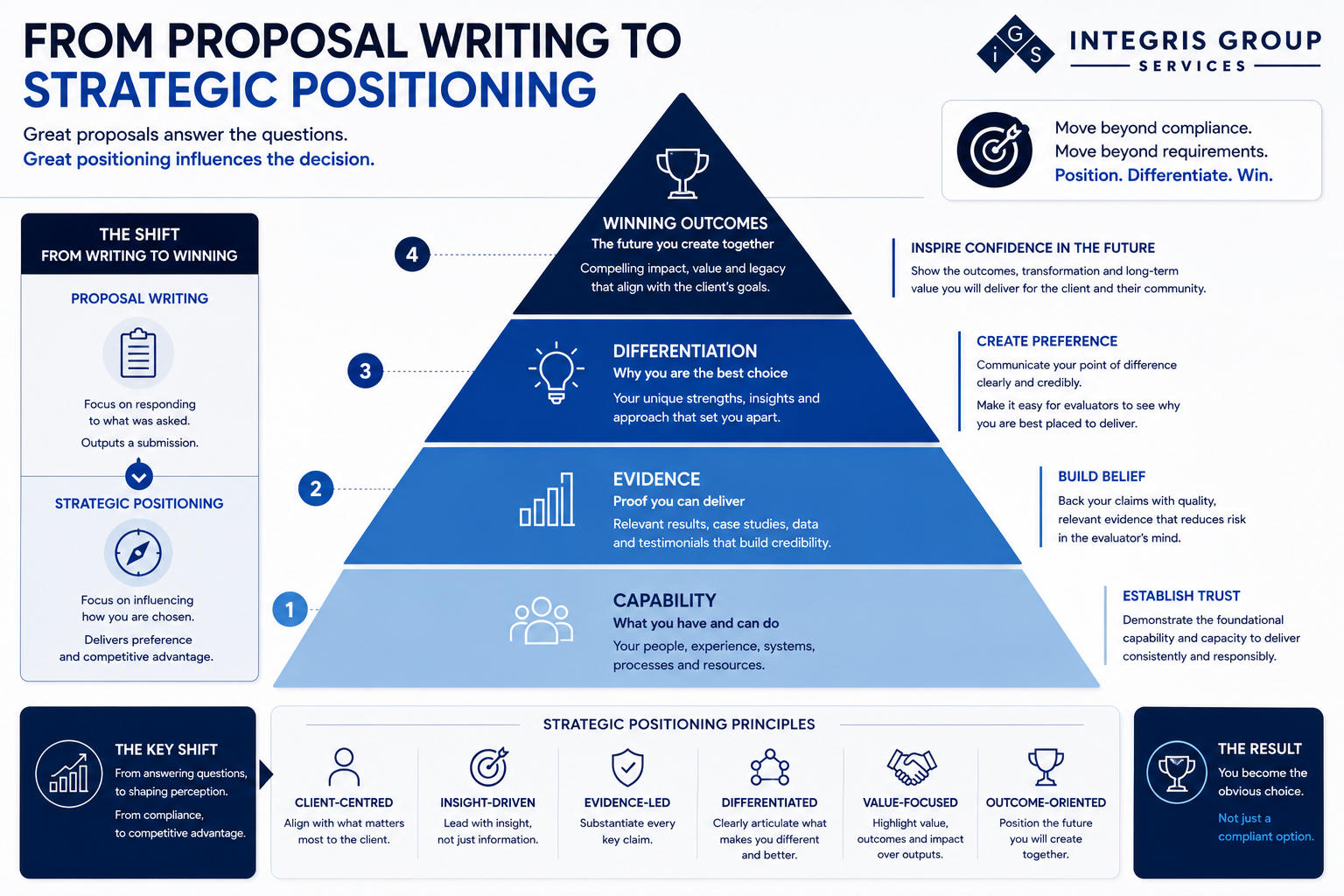
Many organisations view tendering as a writing exercise. While high-quality writing is important, successful tendering is fundamentally a strategic exercise. The strongest Tender Writing Services responses are built upon organisational positioning rather than document production alone. Positioning refers to how an organisation is perceived in relation to competitors, market needs, and evaluator priorities. It influences how capability is presented, how differentiators are communicated, and how value is demonstrated throughout the submission. Organisations with strong positioning understand their strengths, their target markets, their competitive advantages, evaluator expectations, and the outcomes they consistently deliver. This understanding allows them to develop responses that are focused, credible, and aligned with procurement objectives. Strategic positioning often begins well before an opportunity is released. It involves clarifying organisational identity, defining service offerings, strengthening capability documentation, developing evidence of performance, building strategic partnerships, and creating a consistent market presence. When tender opportunities arise, these organisations are not starting from zero. They are leveraging an established position that already communicates capability and value. Writing remains important, but writing alone cannot compensate for weak positioning. The most successful tender responses combine strategic positioning, compelling narratives, strong evidence, effective risk management, governance maturity, and high-quality content development. Together, these elements create a stronger value proposition and help evaluators understand not only what an organisation does, but why it is uniquely positioned to deliver successful outcomes. This broader perspective is why many organisations increasingly view tendering as part of a wider business development strategy rather than a standalone procurement activity. These foundations can be strengthened through Strategic and Operational Consulting, Governance and Sustainability Advisory, and Compliance Management, where organisational systems, governance, and evidence need to support stronger positioning. Through services including Tender Writing Services, Business and Technical Content Writing, Technical Writing Services, Content Writing Services, and Funding and Grant Application Services, Integris Group Services helps organisations strengthen both their submissions and the strategic foundations that support them. The goal is not simply to write better tenders. The goal is to become a stronger contender before the evaluation process even begins.
Learn More →

Common Questions

Tender writing focuses on preparing response content, while bid strategy involves positioning an organisation to maximise competitiveness by aligning strengths, evidence, capability, and messaging with evaluator priorities.

Integris Group Services helps organisations strengthen tender responses through strategic positioning, capability articulation, content development, review processes, and evaluator-focused response strategies.

We assist with government tenders, commercial tenders, panel applications, Requests for Tender (RFTs), Requests for Proposal (RFPs), Requests for Information (RFIs), Requests for Quotation (RFQs), grant applications, and funding submissions.

Many organisations focus heavily on compliance and technical capability but fail to clearly articulate value, differentiate themselves from competitors, or address evaluator priorities effectively.

Yes. We support organisations at all stages of tender maturity, including those preparing their first formal tender submission.

Capability statements often form the foundation of successful tender responses. A well-developed capability statement provides evaluators with confidence that the organisation can deliver the required outcomes.

We support organisations across government, infrastructure, construction, professional services, not-for-profit, health, education, defence, and regulated industries.

Find Us

Let's Build Something Great Together

We'd love to hear from you