How Privacy-Focused Offline AI Works Without Internet: A Technical Guide
Off-Grid AI is a veteran-owned, family-run technology company built around a single core mission: delivering capable, verifiable artificial intelligence that works when the internet doesn't. Developed under the Elastic Thoughts umbrella and closely aligned with the preparedness-focused team behind Mountain Ready, Off-Grid AI produces fully offline, deterministic, citation-bound knowledge systems designed for grid-down scenarios, remote field operations, and any setting where cloud dependency is a vulnerability rather than a convenience. Every system ships on physical media, requires no account or subscription, and transmits zero data — by architecture, not just by policy.
Privacy and offline resilience are not features added to Off-Grid AI — they are the reason it exists. The team behind this product understands from experience that the moments when you most need reliable information are often the exact moments when cloud infrastructure is unavailable, compromised, or simply not trustworthy. Building an AI system that performs without internet, keeps every query on the user's own hardware, and grounds every factual answer in a verifiable source document is the direct expression of that understanding.
This technical guide, originally published on the Off-Grid AI blog at offgridai.io, breaks down exactly how privacy-focused offline AI works — covering local processing, on-device retrieval, cryptographic integrity, deterministic output, and the architecture that makes it possible to deliver genuinely capable AI with zero outbound network calls. You can read the original article here: How Privacy-Focused Offline AI Works Without Internet: A Technical Guide (https://offgridai.io/blogs/news/how-privacy-focused-offline-ai-works-without-internet-a-technical-guide).

Offline AI Solutions for Privacy and Independence
Powerful features designed for modern teams
What Is Privacy-Focused Offline AI?
Privacy-focused offline AI refers to AI systems designed to run effectively without any internet connection. Instead of sending prompts to a remote data center, these systems perform every step of the process — interpreting the question, retrieving relevant knowledge, and generating the answer — locally, on the user's own hardware. Nothing leaves the machine.
This local-first design is what makes the privacy guarantee real rather than merely promised. When there is no network call, there is no telemetry to leak, no cloud log to subpoena, and no third party in the loop at any stage. The result is an AI system that can be used in sensitive, remote, or deliberately private settings without compromising the confidentiality of the data being processed.
Off-Grid AI is built around exactly these principles. The system runs entirely offline after first boot, with zero outbound network calls — a property that can be confirmed by inspecting network activity while it runs. There is no telemetry by default, no cloud callback, and no data exfiltration path, because the architecture simply has nowhere to send data. For the self-reliant individual or field team that needs capable AI without cloud dependency, that is the baseline requirement — and it is what Off-Grid AI was built to deliver.

Edge AI, Local Processing, and the Privacy Architecture
Offline AI is built on the foundation of edge AI — the practice of running computation at or near the point where data is generated, rather than on centralized servers. By processing locally, edge AI reduces latency, removes dependence on network bandwidth, and keeps data physically close to its owner. Offline AI takes this one step further by removing the network dependency entirely during normal operation.
The security implications of this architecture are significant. Confining all processing to the local device removes the most common avenues of data exposure: interception during transit, server-side breaches, and silent background telemetry. For anyone handling sensitive material — medical information, legal matters, operational security plans, or personal records — this design represents a meaningful structural improvement over cloud alternatives.
Off-Grid AI reinforces this with layered integrity controls that function without any network connection. Cryptographic signatures and hash verification protect the knowledge base, models, and runtime — if any component is altered, the system detects the mismatch and refuses to run. Device-bound delivery ties the system to specific hardware, so copying the contents to another drive does not produce a working system. Security here is a property of the architecture itself, not a service that requires trusting a third party to maintain.
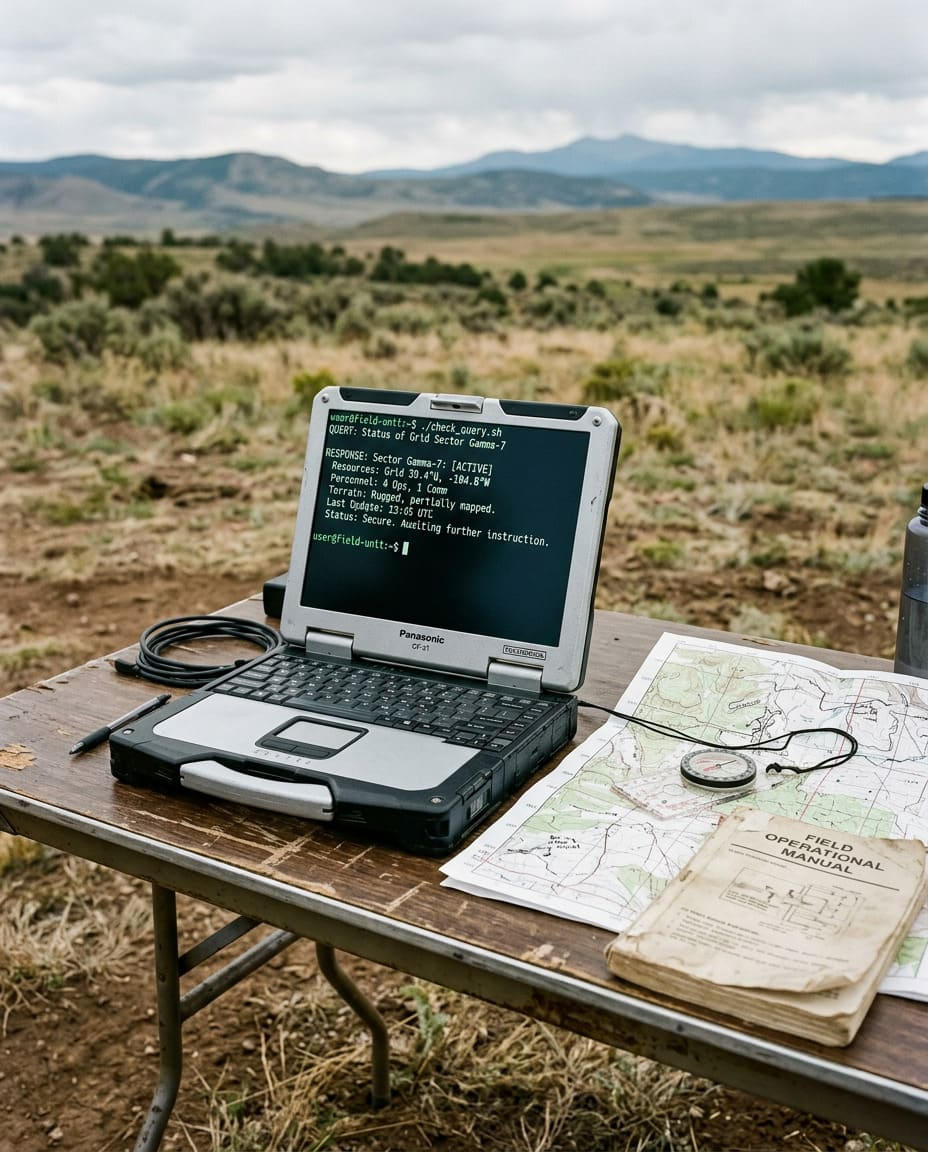
How Offline AI Stays Accurate — Grounding, Determinism, and Fail-Closed Design
A common concern about local AI is accuracy — specifically the risk of hallucination, where a model confidently states something that is not true. Off-Grid AI addresses this not with a single technique but with a design philosophy: integrity over coverage, and verification over convenience. The key mechanisms are citation-bound answers, deterministic output, and fail-closed behavior working together.
Citation-bound answers ground every factual statement in a source document from the local knowledge base. Responses are not pulled from a model's open-ended internal memory — they are anchored to retrieved, verifiable material that the user can trace and confirm. Deterministic output means that given the same question and the same knowledge base, the system returns the same answer every time, making it auditable and trustworthy rather than unpredictable.
Fail-closed behavior completes the architecture: when the system does not have enough verified information to answer well, it says so rather than guessing. The design principle is that the system is allowed to be incomplete but not allowed to be incorrect — and not allowed to hallucinate. For preparedness applications where a wrong answer in a medical, mechanical, or security context can have real consequences, this is not a limitation. It is the correct design for a tool people will rely on when it matters most.

The Technical Components That Enable AI Without Connectivity
Offline AI relies on several technical components working together. Local hardware provides the compute needed to run inference on-device — modern consumer and professional machines are well within range, with no specialized data-center equipment required. Efficient on-device models made practical through quantization — compressing model weights to lower-precision formats — allow capable AI to run on everyday hardware without sacrificing the reliability needed for real-world field use.
The local retrieval layer is the heart of how offline AI stays both useful and accurate. Source documents are processed into local semantic embeddings and stored in an on-device vector index with no external database or API involved. When a question is asked, the system searches that index for the most relevant material and uses it to ground the answer. Because the entire pipeline runs locally, neither queries nor documents are ever transmitted externally — and every answer carries a traceable path back to the underlying source material.
Off-Grid AI delivers these components in a USB form factor that is practical for field deployment. The complete operating environment — models, knowledge base, retrieval index, and runtime — ships on a single physical drive. Inserting the drive triggers an integrity verification sequence using cryptographic signatures and hash checks; once confirmed, the system initializes and is ready for queries. This plug-and-play workflow removes the configuration burden typically associated with self-hosted AI and operates identically whether the host machine is online or completely disconnected.

Practical Use Cases and the Case for Offline AI in Preparedness
Offline AI proves its value most clearly in scenarios where connectivity is unreliable, undesirable, or absent — and where the cost of a wrong or leaked answer is high. Emergency and disaster response, where networks may be down but decisions cannot wait, represents perhaps the clearest use case. Wilderness and field medicine applications — trauma, cardiac, and infection management in austere environments — benefit directly from a system that provides grounded, citation-backed guidance with no signal required.
Homesteaders and off-grid communities have equally direct applications: off-grid power repair, vehicle and equipment troubleshooting, livestock and animal care, and food production guidance are all knowledge domains where reliable offline access matters and where submitting sensitive operational queries to a cloud platform is neither practical nor appropriate. For security-focused users, tactical operations and situational awareness references that never touch an external server represent a meaningful operational security upgrade.
In each of these cases, the same core promise applies: capable, grounded answers, available anywhere, with data remaining entirely under the user's control. Offline AI is not a compromise technology — for privacy-sensitive, field, and off-grid work, it is a better model. More private, more resilient, and more trustworthy than cloud alternatives that depend on infrastructure that may not be available when it matters most. Learn more about how Off-Grid AI is built and what it covers at offgridai.io.

Frequently Asked Questions
Privacy-focused offline AI refers to systems that perform every step of the AI process — interpreting a question, retrieving relevant knowledge, and generating an answer — locally, on the user's own hardware. Nothing leaves the machine. There is no network call, no remote server processing the prompt, and no third party involved at any stage. The privacy guarantee is architectural, not policy-based.
Cloud AI operates in the opposite way. Every prompt submitted is transmitted over the internet to a remote data center, processed on external infrastructure, and returned as a response. Inputs can be logged, analyzed, retained, and potentially used to train future models — often without meaningful user control over how or when that happens.
For self-reliant individuals and preparedness-minded users, the distinction is operationally significant. Cloud AI fails entirely when connectivity is lost and exposes sensitive queries by design. Offline AI keeps working during outages, in remote environments, and in deliberately disconnected settings — and it keeps data exactly where it belongs: on hardware the user controls.
Edge AI is the practice of running artificial intelligence computation at or near the point where data is generated, rather than sending that data to centralized servers. By processing locally, edge AI removes latency introduced by network round-trips, eliminates dependence on bandwidth availability, and keeps data physically close to its owner — under direct control.
Offline AI takes the edge AI model one step further by removing the network dependency entirely. The system does not just process locally during normal use — it has no outbound network calls at all during operation. This makes it suitable for air-gapped environments, grid-down scenarios, and any setting where connectivity is unreliable, undesirable, or absent.
The practical benefits of this local-first design fall into three clear categories: reliability during connectivity loss, complete control over data, and immediate access to responses governed only by local hardware — not network conditions or server availability. For emergency responders, preppers, and field operators, all three of those properties matter enormously.
By confining all processing to the local device, offline AI removes the most common avenues of data exposure: interception during transit, server-side breaches, and silent background telemetry. For anyone handling sensitive material — patient information, legal matters, operational security, or personal records — this architecture represents a meaningful structural improvement over cloud-based alternatives.
A well-designed offline AI system reinforces this with layered integrity controls that do not depend on the internet. These include verified zero telemetry — where the default configuration makes no automatic network calls — and cryptographic integrity protections where the knowledge base, models, and runtime are protected with digital signatures and hash verification. If any component is altered, the system detects the mismatch and refuses to run.
Device-bound delivery adds another layer: the system is cryptographically tied to its hardware, meaning copying the contents to another drive does not produce a working system. Crucially, all of these guarantees hold without a network connection. Security is a property of the architecture itself — not a service that depends on trusting a third party to maintain it.
Retrieval-augmented generation is a technique that allows an AI system to search a local knowledge base before generating a response. Rather than relying solely on what a model learned during training, a RAG-enabled system converts source documents into local semantic embeddings — numerical representations of meaning — and stores them in an on-device vector index. When a question is submitted, the system searches that index for the most relevant material and uses it to ground the answer.
Because the entire pipeline runs locally, neither queries nor documents are ever transmitted to an external server. Answers are anchored to retrieved sources, which means every factual claim can be traced back to the underlying material — a critical property for high-trust field and reference applications where a wrong answer carries real consequences.
Research consistently shows that grounding model outputs in retrieved documents substantially reduces hallucination compared to relying solely on a model's internal parameters. A properly implemented offline RAG system takes this further by requiring a citation for factual claims and refusing to answer when retrieval is insufficient — a fail-closed approach that treats incomplete information as preferable to an unverified guess.
Deterministic output means that given the same question and the same knowledge base, the system returns the same answer every time. This reproducibility is unusual among generative AI systems, which typically produce slightly different responses to identical prompts due to the statistical sampling methods used during generation. In Off-Grid AI, determinism is a deliberate design choice, not a side effect.
For preparedness and field applications, determinism has significant practical value. It makes the system auditable: you can verify what it will say in response to a known question, compare responses across sessions, and build confidence through consistent, repeatable results. A system that might say something different each time is a liability when the stakes are high.
Combined with citation-bound answers and fail-closed behavior — where the system acknowledges the limits of its knowledge rather than guessing — determinism produces a tool that is trustworthy in a way that open-ended generative AI is not. The design philosophy is integrity over coverage and verification over convenience, which aligns directly with how serious preparedness planning approaches any critical resource.
Quantization is a compression technique that reduces the numerical precision of a model's parameters — for example, converting 16-bit floating point values to lower-precision integer formats. This shrinks the memory footprint of the model significantly without eliminating most of its reasoning capability. A model that might require tens of gigabytes of memory at full precision can be reduced to a fraction of that size through quantization.
For offline AI deployments, quantization is what makes local inference practical on consumer and professional hardware rather than requiring specialized data center equipment. Modern laptops and desktops are well within the range needed to run capable quantized models, including on CPU-only machines for smaller model sizes. This accessibility is what has moved local AI from a research concept to a tool that individuals and small teams can actually deploy in the field.
The trade-off is a modest reduction in output quality compared to full-precision inference. In practice, for focused, domain-specific knowledge work — the kind that preparedness and field applications demand — a well-quantized model paired with a local retrieval layer delivers results that are highly competitive with cloud alternatives, while maintaining the privacy and offline resilience that cloud systems cannot offer.
A USB-delivered offline AI system packages the complete operating environment — model weights, knowledge base, retrieval index, and runtime software — onto a single physical storage device. The user inserts the drive into a compatible machine, the system verifies its own integrity using cryptographic signatures and hash checks, the local engine initializes against the bundled models and knowledge base, and the user begins querying — fully offline, with no installation or configuration required.
Physical media delivery has meaningful security advantages over network distribution. There is no download to intercept, no account to compromise, and no transmission path that could be monitored. The contents are protected at rest and verified at launch, so the user can confirm that what they're running is exactly what was originally packaged — unmodified and untampered.
Portability is an equally important advantage. A self-contained USB system can be transported, stored securely, and deployed on any compatible host machine across macOS, Windows, and Linux. For preppers and field operators who need a knowledge resource that travels with them and works anywhere a powered device can operate, this form factor is significantly more practical than a locally installed software stack tied to a single machine.
Because the knowledge base and models are fixed at build time, the system's behavior is stable and reproducible — it does not silently learn, change, or update at runtime. This stability is a feature, not a limitation. For high-trust reference applications, knowing exactly what version of the knowledge base the system is drawing from is a meaningful reliability property.
When updates are warranted, they are delivered as signed update packages that are cryptographically verified before being applied. This process keeps the door closed to tampering while still allowing the knowledge base to grow over time. Updates are user-initiated, not automatic — nothing changes in the background without the user's awareness and consent.
Optional expansion packs extend the core knowledge base into specialized domains — field medicine, veterinary care, electrical work, mechanical repair, tactical operations, and agriculture — and follow the same verification model. Each addition is a deliberate, confirmed action rather than a background process, maintaining the integrity and isolation of the system while giving users a clear path to expanding its coverage as their needs evolve.
Offline AI offers strong advantages in privacy, resilience, and trustworthiness — but honest evaluation requires acknowledging the trade-offs. On the hardware side, inference runs on local compute, which means capable — though widely available — hardware is required. Response speed is determined by the host machine's CPU and GPU capabilities rather than by data center resources.
On the knowledge side, a fixed, verified corpus is a deliberate feature for trust and auditability — but it means the knowledge base advances through deliberate, signed releases rather than updating continuously. For most field and reference use cases, this stability is exactly what you want: a consistent, verifiable source that behaves the same way every time. For users who need up-to-the-minute general knowledge on rapidly changing topics, a cloud tool remains a better fit for that specific task.
The competitive picture on accuracy is more nuanced than many assume. Offline systems typically run smaller, quantized models rather than the largest cloud-scale architectures. But for focused, domain-specific work — especially when paired with a local retrieval layer — a grounded offline system can outperform a cloud model that generates confident but unverified responses. For knowledge work where accuracy and verifiability matter more than open-ended creativity, the offline model has a genuine advantage.
Off-Grid AI's core system spans the knowledge domains that matter most when infrastructure fails and decisions cannot wait: field medicine, water procurement and treatment, food production and preservation, off-grid power, emergency communications, navigation, sanitation, personal security, and situational awareness. These foundational domains cover the essential skill sets underpinning serious preparedness planning across a wide range of grid-down and austere scenarios.
Specialized expansion packs extend that core into professional-depth domains. Field medicine packs cover trauma, cardiac, and infection management for austere environments. Veterinary packs address livestock and animal care for homesteaders and farms operating without veterinary access. Electrical and mechanical packs provide off-grid power repair and vehicle troubleshooting capability. Tactical and agricultural packs round out the coverage for security-focused and food-production applications.
The value of this structured knowledge architecture becomes clearest in the scenarios where it matters most: grid-down emergencies, extended wilderness operations, remote homestead situations, and any context where connectivity is absent and the cost of a wrong answer is high. A system that provides grounded, cited, reproducible guidance across all of these domains — without a network connection, without a subscription, and without transmitting a single query to an external server — is a genuinely capable addition to an integrated preparedness plan.
Find Our Office
Ready to Transform Your Business?
Join thousands of companies already using our platform