Crane Test Weights for Planned Load Testing | Tenwinkel
Tenwinkel GmbH & Co. KG is a German manufacturer of heavy-concrete and steel components for industrial applications. Its crane test weight portfolio is designed around modular, stackable units that can be configured for a defined load, handling concept and site situation. Depending on the project, the specification may address dimensions, markings, coating, lifting eyes, forklift pockets, transport aids and the sequence in which individual units are assembled. The company supplies the physical test weights and related handling solutions; it does not carry out crane inspections, certify lifting equipment or decide whether a test has been passed. Those responsibilities remain with the competent operator, engineer, inspection body or other qualified party. Tenwinkel also manufactures tractor weights, technical counterweights, heavy-concrete components, bollards and mobile vehicle barriers, but the present Cloud Stack concentrates on crane test weights. Concrete and heavy-concrete units must not be described as calibrated or legal-for-trade measuring instruments. The stated production tolerance for this product context is only -0/+2.5%, and any project-specific suitability must be checked against the approved drawings, lifting plan, transport route and applicable requirements before use.
Crane Test Weights: Planning Modular Loads for Safe Test Procedures
Curated with love, crafted for you
 POPULAR
Planning crane test weights from the required test load
A crane load test begins with a documented technical requirement, not with a generic set of blocks. The responsible operator, engineer or inspection party first defines the crane configuration, the required test load, the applicable procedure and the acceptance criteria. Those decisions determine how much physical load is needed, how accurately the load must be represented, where it can be positioned and which handling method is suitable. Tenwinkel GmbH & Co. KG supports this planning stage as a manufacturer and supplier of crane test weights. It does not perform crane inspections, certify lifting equipment or decide whether a crane has passed a test.
A useful enquiry therefore starts with the required total load and the increments in which that load should be assembled. The planner should also provide the available headroom, footprint, access route, lifting equipment and any restrictions at the test location. A compact stack may be appropriate where floor area is limited, while smaller increments may be preferable when the load must be increased in controlled stages. The same nominal total can lead to very different systems when transport dimensions, lifting points or local ground conditions change.
The physical properties of the proposed units must be understood correctly. Tenwinkel produces concrete and heavy-concrete test weights with a stated tolerance of -0/+2.5% in this product context. These weights are not calibratable and are not legal-for-trade measuring instruments. The responsible technical party must decide whether the documented unit weights, tolerance and configuration are suitable for the intended procedure. A manufacturer quotation or drawing does not replace the project-specific test plan.
Project data should distinguish the load required by the procedure from the tare mass of pallets, frames, lifting accessories or transport equipment. It should also state whether individual units need permanent identification, how the assembled load will be documented and whether the same set will be used at more than one site. Early clarification helps prevent a system from being dimensioned around an incomplete assumption.
The objective is a traceable configuration that can be manufactured, transported, handled and assembled as planned. That requires cooperation between the purchaser, the competent inspection party, the crane operator, the lifting team and the weight supplier. Tenwinkel can translate the agreed load concept into product geometry and handling features, while operational responsibility remains with the qualified parties controlling the test.
 POPULAR
Modular systems, load increments and project-specific details
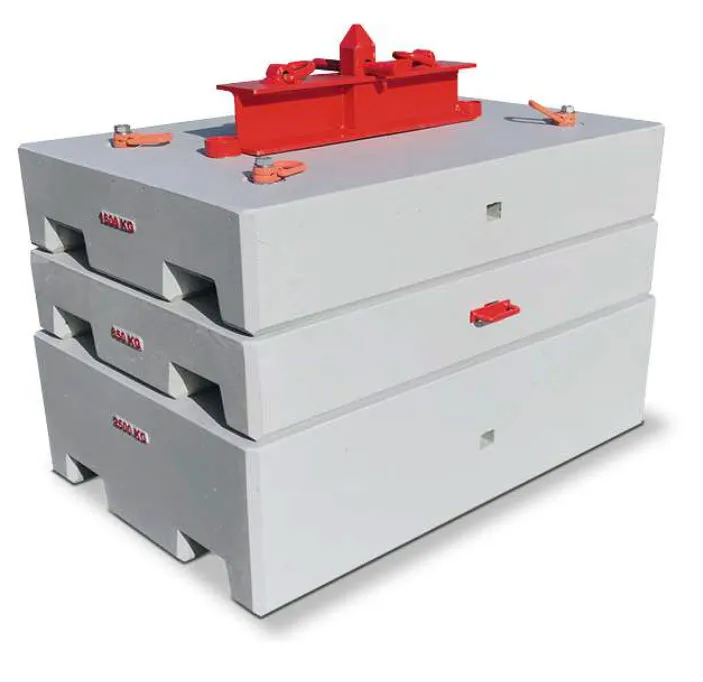
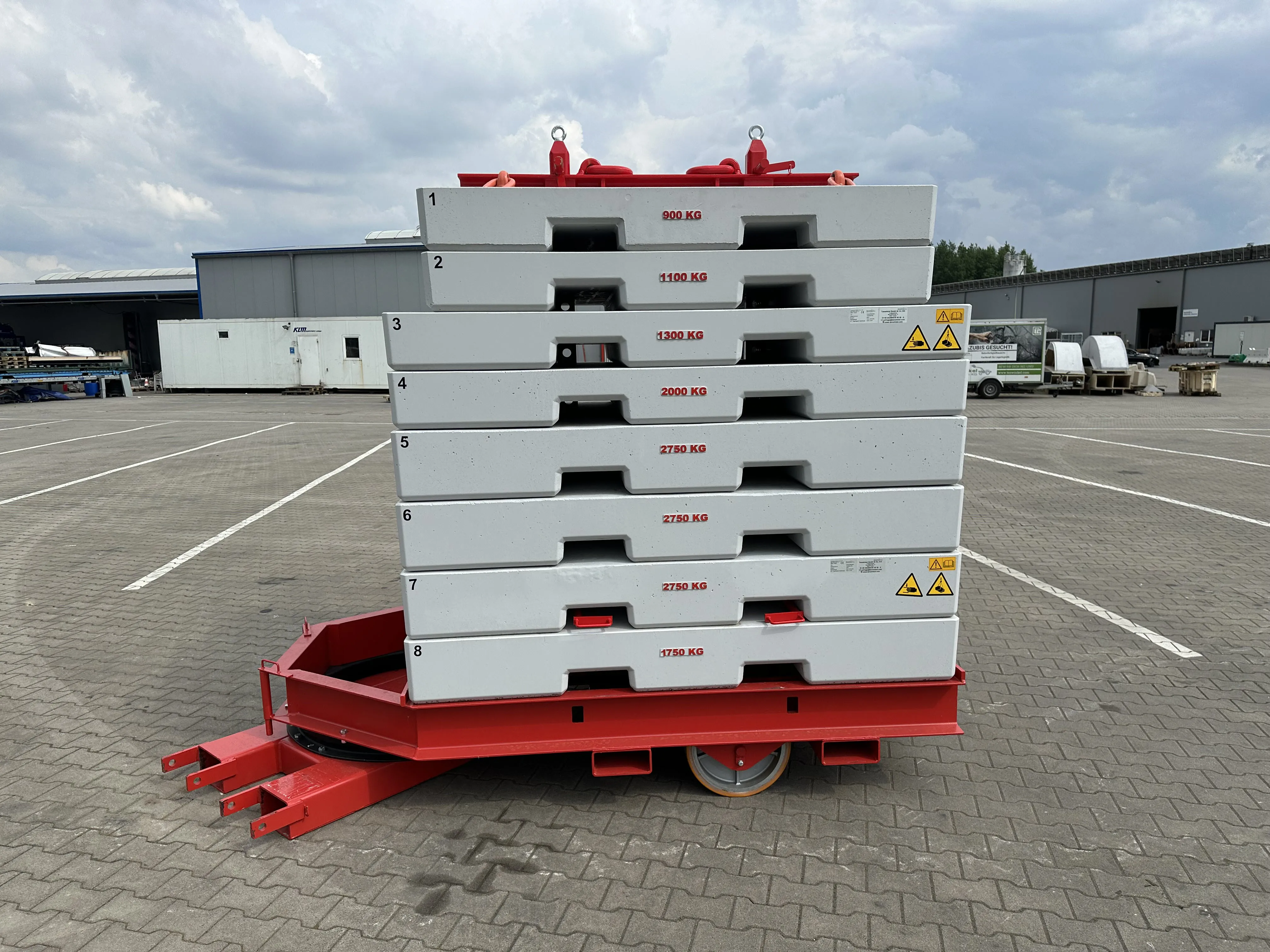
Modularity is valuable because a single crane test weight rarely represents every load stage required by a procedure. A stackable system can combine individual units into several defined configurations. The planner can specify larger base units for efficient build-up and smaller increments for the final stages. The appropriate combination depends on the test plan, available handling equipment and the permissible height and footprint of the assembled stack.
Tenwinkel can discuss project-specific dimensions, markings, coatings, lifting eyes, forklift pockets and transport aids. These are not decorative options. Each detail affects how the system is identified, moved, stacked, stored and maintained. A forklift pocket must suit the intended forks and approach direction. A lifting point must be considered together with the approved lifting accessory and the unit's centre of gravity. Markings should make individual units and their documented masses easy to match without creating confusion between similar blocks.
The design discussion should state whether units will be lifted individually, moved on a platform or combined before positioning. It should also identify the maximum allowable stack height, expected surface conditions and any clearance needed around connection or lifting features. Where the system must travel between sites, transport dimensions and securing concepts should be considered before geometry is fixed. A configuration that works in a permanent test area may be inefficient when frequent loading, unloading and road transport are required.
Concrete and heavy concrete allow substantial mass within robust shapes, but they must be specified for their actual function. The material is not a substitute for calibrated reference masses, and the units must not be presented as legal-for-trade. The -0/+2.5% production tolerance should be reflected in the technical documentation and in the competent party's suitability assessment. If a procedure requires a different measurement concept, that requirement must be resolved before ordering.
The supporting Tenwinkel page on crane testing systems and crane load testing provides additional product context. It should be read together with the approved quotation, drawings and project documentation. Neither a web page nor a visual example establishes that a particular geometry, load increment or handling feature is appropriate for another site.
A well-defined modular system gives the operating team a predictable sequence. Each unit has an assigned place, the configuration can be recorded, and future use can refer back to the same identification. Changes to the intended crane, site, lifting method or test procedure require a fresh review rather than an assumption that the original arrangement remains suitable.
Handling, transport, storage and site preparation
The usefulness of a crane test weight system depends on more than its total mass. The units must reach the test area, remain identifiable and be handled through a controlled sequence. Planning should begin with the full route from storage or delivery vehicle to the final test position. Gate widths, turning space, gradients, floor loading, overhead restrictions and weather exposure can all affect the appropriate design and logistics.
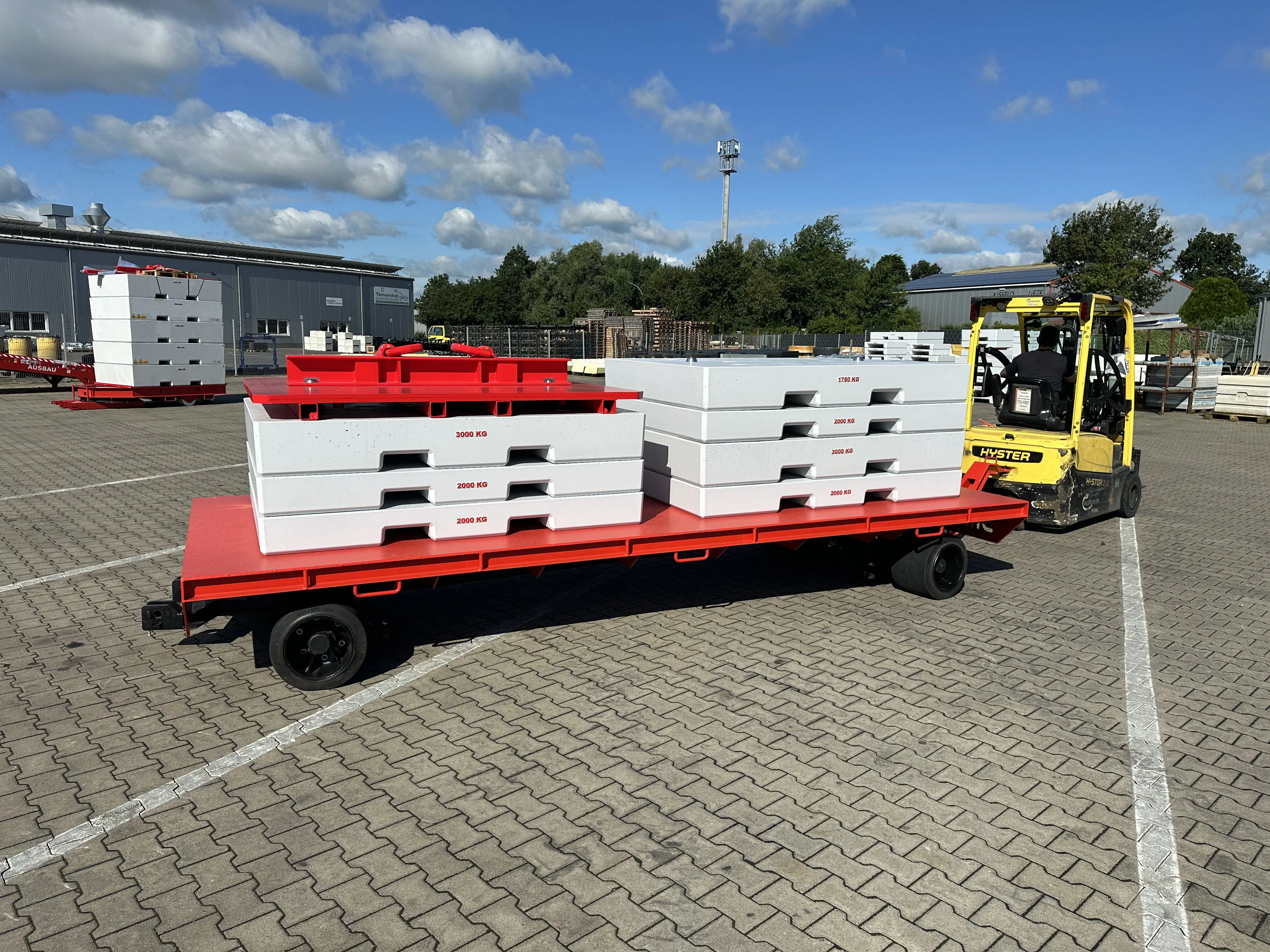
If forklift handling is planned, the purchaser should document fork dimensions, truck capacity, load centre and the directions from which a unit can be approached. Forklift pockets do not by themselves confirm that a specific truck or manoeuvre is safe. If overhead lifting is planned, the qualified lifting team must define the accessories, connection method, lifting plan and exclusion zone. Lifting eyes and other interfaces must be used only as documented and inspected as required by the responsible organisation.
Transport aids can reduce repeated handling, but they also introduce their own mass, dimensions and securing requirements. A wheeled platform may support movement on a suitable surface, while a different site may require direct lifting or forklift access. Road transport requires a separate load-securing assessment by the competent carrier. Tenwinkel can manufacture agreed product and handling features, but it does not replace the carrier, lifting supervisor or site safety authority.
Storage conditions should protect identification and preserve safe access for later use. Units should not be stacked on an unverified surface or arranged so that water, contamination or impact can conceal damage. The owner should establish inspection, cleaning and record-keeping routines appropriate to the product, environment and frequency of use. Any visible damage, altered lifting feature or uncertainty about identity should be resolved before the unit is handled.
The official Tenwinkel company website shows the broader manufacturing context, including technical counterweights and other heavy-concrete products. Those examples can demonstrate manufacturing capability, but crane test weights require their own project specification. Tractor weights, bollards or mobile vehicle barriers should not be treated as interchangeable with a documented crane test weight configuration.
Site preparation should be completed before the weights arrive. The operating team needs a defined staging area, controlled access, suitable lighting and a method for checking the planned sequence against the documentation. Communication roles should be clear, especially where several organisations share the site. No one should enter an exclusion zone or improvise a handling method merely because the physical blocks appear simple or robust.
Documentation, traceability and technical responsibility
Traceability connects each physical unit with the project specification. The documentation should identify the unit, its stated mass, relevant tolerance, geometry, handling interfaces and any agreed coating or marking. Where several units look similar, a clear numbering system helps the team assemble the intended load without relying on colour, position or memory. Records should be retained in a form that the responsible operator can use during planning and future reviews.
The distinction between product documentation and inspection documentation is important. Tenwinkel can provide information relating to the manufactured weights. The crane operator, competent engineer, inspection body and other responsible parties create and retain the documents for the crane, the load-test procedure, the lifting accessories, the site and the test result. A supplied weight does not certify the crane, and a product data sheet does not approve the overall operation.
Before use, the team should compare the available units with the current plan. Identification, visible condition and configuration should be checked, and the effect of the stated -0/+2.5% tolerance should be understood. The planner must not describe heavy-concrete units as calibrated or legal-for-trade. If the procedure requires traceability to calibrated measurement equipment or a tighter uncertainty statement, a competent specialist must define an appropriate alternative.
Changes deserve formal attention. A new crane configuration, altered test load, different site, changed lifting equipment or modified transport route can invalidate assumptions used for the original system. Reusing the same blocks does not automatically make the original method transferable. The responsible parties should document the change, assess its consequences and obtain any necessary revised drawings or instructions.
Safety controls remain operational responsibilities. These include verifying ground capacity, controlling access, checking lifting accessories, observing equipment limits, defining communication signals and responding to weather or visibility. Test weights should never be suspended, stacked or moved outside an approved method. Tenwinkel's role is to manufacture the agreed physical system, not to supervise these activities or warrant a successful test outcome.
Clear commercial documents also prevent misunderstanding. A request should distinguish required and optional features, identify who supplies transport or handling equipment and state which documentation is included. Any assumption that matters to suitability should be confirmed before production. This approach makes comparison between proposals more meaningful than choosing units solely by nominal mass or price.
From technical enquiry to a reviewable crane test weight specification
A productive enquiry gives Tenwinkel enough verified information to prepare a reviewable proposal. The starting package should include the required load stages, preferred increments, intended handling method, available equipment, site footprint, access restrictions and transport concept. It should identify the people or organisations responsible for the crane test, lifting plan and acceptance criteria. Drawings or photographs can provide context, but critical dimensions and capacities must be stated explicitly.
Tenwinkel can then discuss a modular arrangement and document the proposed unit sizes, markings and interfaces. The purchaser and competent technical parties review whether the arrangement fits the procedure and site. Questions about ground loading, crane capacity, lifting accessories, exclusion zones or inspection requirements must be answered by the responsible specialists. Production should follow only after the relevant specification and responsibilities are clear.
Official contact and product information should be checked through Tenwinkel's own website. The company's Publishing Details identify the website operator, while the Data Protection information explains the handling of personal data. These legal resources are included as verification links rather than as substitutes for project documents or direct technical communication.
The accompanying official video illustrates Tenwinkel crane testing systems and provides useful visual context for modular units and handling. It is not an operating instruction. Viewers should not infer capacities, connection methods or procedures from images alone. Only the approved specification, product documentation and project-specific lifting and test plans should guide actual work.
This page was prepared with AI assistance and reviewed as informational project content. AI-generated material can be incomplete, outdated or inaccurate. Product details, availability and company information should be verified through the official Tenwinkel website or direct contact. Nothing on this page constitutes engineering, crane-inspection, certification, lifting or safety advice. Qualified personnel must assess the crane, test procedure, ground conditions, lifting accessories, transport, handling and local requirements before any weight is moved or used.
A sound crane test weight project ends with a configuration that can be explained and checked. The mass concept, tolerance, unit identification, handling interfaces, logistics and responsibilities should all be visible in the documentation. That discipline supports efficient preparation without blurring the boundary between the manufacturer's product role and the competent parties responsible for the test.
Our Brand Story
Discover what makes us different
Common Questions
Crane test weights provide a defined physical load for procedures such as commissioning tests, periodic examinations, maintenance checks or other planned load-test activities. The competent operator or inspection party determines the required procedure and acceptance criteria. Tenwinkel manufactures and supplies the weights; it does not perform the inspection or certify the crane.
No. Tenwinkel's concrete and heavy-concrete test weights are not calibratable and are not legal-for-trade measuring instruments. For this product context, the stated production tolerance is -0/+2.5%. The responsible technical party must decide whether that tolerance and the documented configuration are suitable for the intended test plan.
Yes, the system can be planned around the required total load, unit sizes, stacking sequence and handling method. Depending on the agreed design, relevant details can include dimensions, identification markings, coating, lifting eyes, forklift pockets and transport aids. The final specification must be documented and checked before production and use.
Useful information includes the required total load, preferred increments, available lifting equipment, permitted lifting points, forklift access, transport restrictions, ground conditions and storage concept. Photographs or drawings of the intended work area may support the discussion, but they do not replace a project-specific lifting and safety assessment.
The crane operator and the competent inspection, engineering or safety personnel remain responsible for the procedure, exclusion zones, lifting accessories, ground capacity, weather limits and acceptance criteria. Tenwinkel supplies the agreed weights and associated product documentation but does not assume the role of the inspection body.
Visit Our Store
Ready to Experience the Difference?
Join our community of happy customers today