Trusted by Industry Leaders

Change Management Consulting for Organisational Transformation

Organisational change rarely fails because people do not understand the announcement. It fails when change is poorly governed, disconnected from project delivery, unsupported by leaders, or not embedded into the way people work.

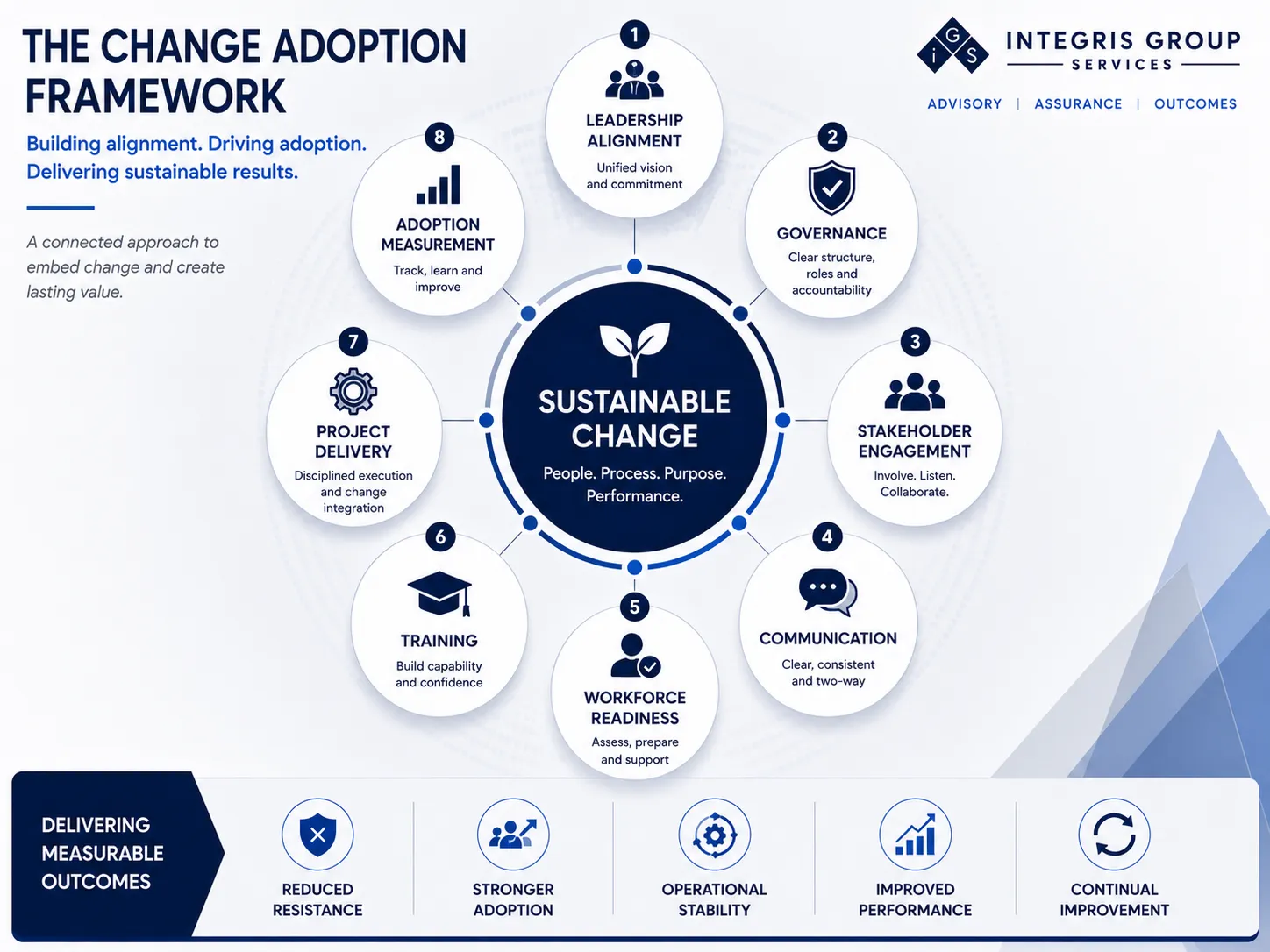
At Integris Group Services, we provide change management consulting that helps organisations plan, implement and sustain meaningful transformation. Our approach moves beyond communication plans and training schedules to focus on the practical systems required for change to succeed, including governance, stakeholder engagement, leadership alignment, workforce readiness, project delivery, capability uplift and operational adoption.

We support organisations in Melbourne and across Australia through periods of transformation, including operating model changes, service redesign, technology implementation, compliance uplift, workforce transition, process improvement and strategic reform.

By embedding change management into project delivery and organisational governance, we help leaders reduce resistance, improve adoption, strengthen accountability and ensure transformation delivers practical outcomes. This approach is often supported through broader PMO Consulting and Management and Operations Consulting initiatives that align projects, people, governance and organisational objectives.

Our focus is not simply getting people through change. It is helping organisations build the internal capability, confidence and systems required to sustain change over time. This includes strengthening workforce capability through effective leadership, engagement and organisational development practices that support long-term adoption and continuous improvement across the organisation
Change Management Consulting for Organisational Transformation

Making Change Stick: Practical Change Management for Organisational Transformation

Our core competencies
Why Change Management Is More Than Communication
Why Change Management Is More Than Communication

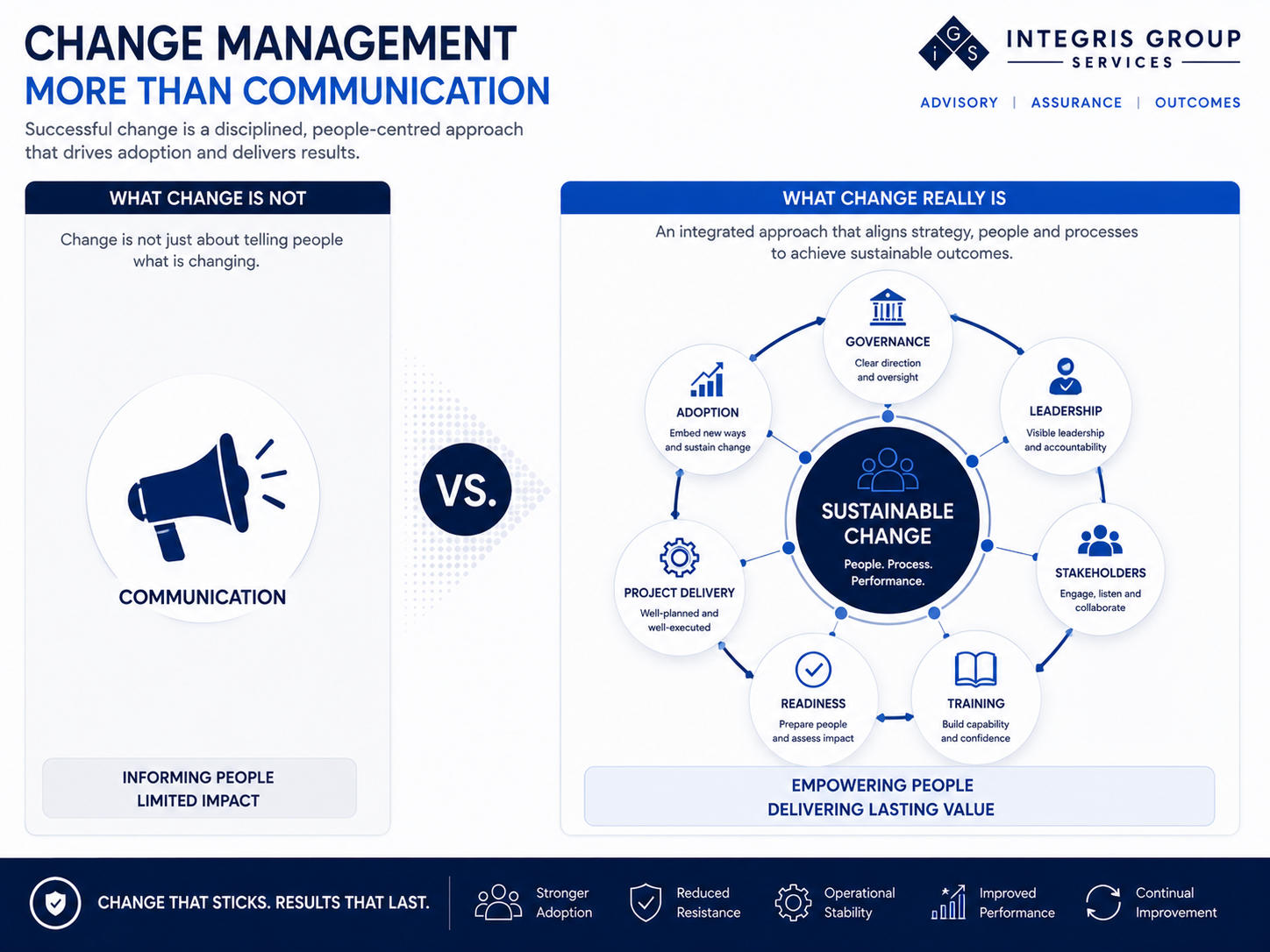
Many organisations associate change management with communication plans, staff briefings, and training sessions. These activities are important, but they represent only part of what is required for change to succeed. Real change management is about helping people, teams, and organisations move from current ways of working to new ways of operating. This requires more than telling people what is changing. It requires governance, planning, leadership alignment, stakeholder engagement, operational readiness, and practical implementation support. Change often fails when organisations underestimate the gap between a decision being made and a change being embedded. A new system may be implemented, a new structure may be announced, or a new process may be approved, but this does not mean the organisation has changed in practice. Employees still need to understand what the change means for their role, how their work will be affected, what support is available, and how success will be measured. Managers need clarity on expectations, accountabilities, and escalation pathways. Leaders need to communicate consistently and reinforce the change through their decisions and behaviours. This is why change management should be treated as an operational discipline, not a communications activity. At Integris Group Services, we help organisations embed change management into the practical systems that support transformation. This includes connecting change planning with governance, project delivery, workforce readiness, training, communication, and post-implementation review. Successful change initiatives are often supported by strong PMO Consulting practices that align project delivery, stakeholder engagement, governance, reporting, and organisational outcomes. Where change involves significant service redesign or operating model reform, organisations may also benefit from broader Service Transformation Consulting support to ensure that change activities remain aligned with strategic objectives and service delivery requirements. When change management is too narrow, organisations risk achieving technical implementation without meaningful adoption. The system goes live, the process is published, or the restructure is completed, but people continue to work around the change because it has not been properly embedded. Sustainable change requires people to understand, accept, and apply new ways of working. That can only occur when change is planned, governed, and supported from the beginning. Strong organisational change also depends on leadership capability, workforce engagement, and alignment with broader Management and Operations Consulting initiatives that help organisations connect people, processes, governance, and performance. The strongest change management approaches therefore focus not only on what needs to be communicated, but on what needs to be understood, adopted, reinforced, and sustained.
Learn More →
Why Organisational Change Initiatives Fail
Why Organisational Change Initiatives Fail

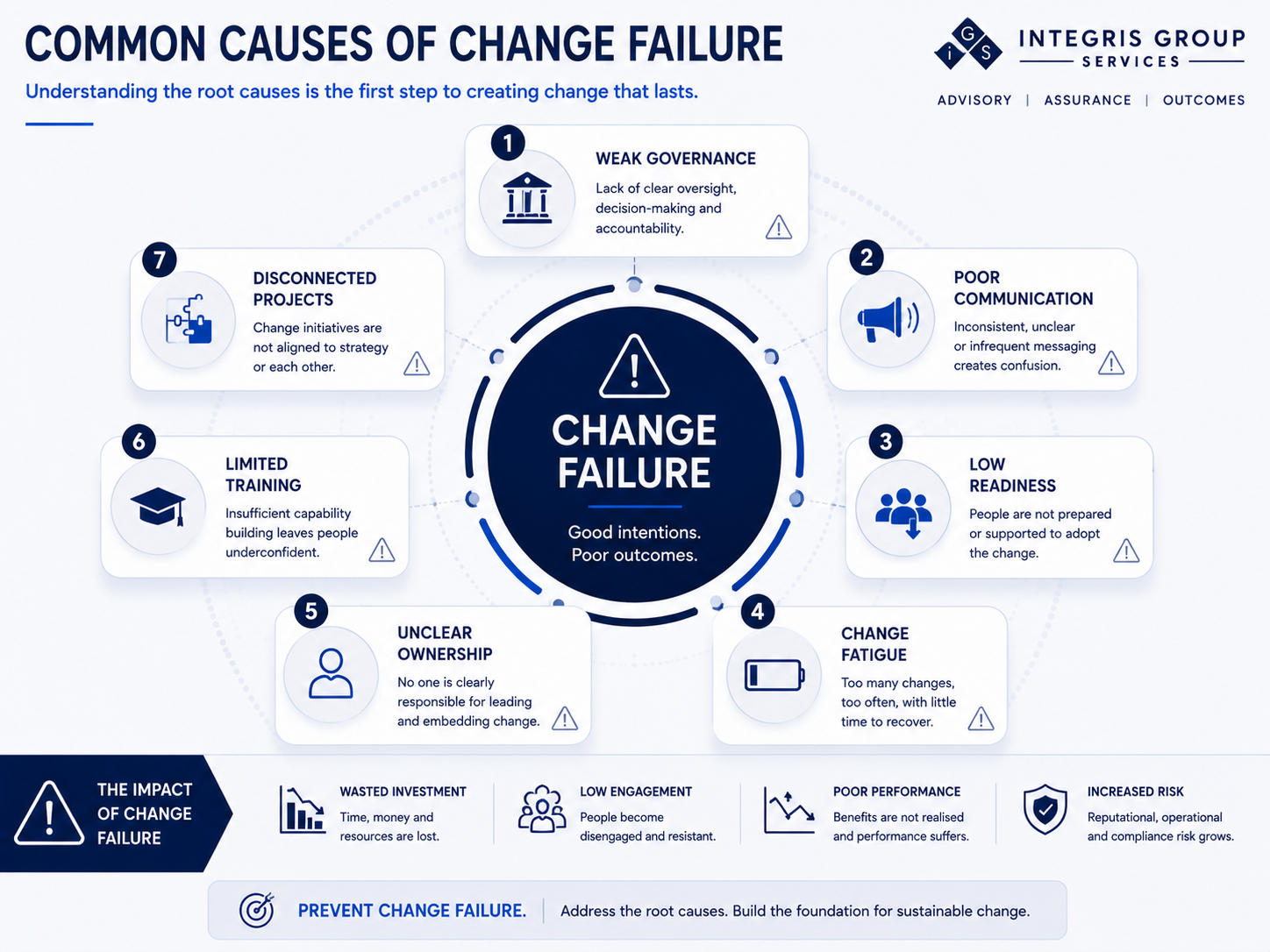
Organisational change initiatives rarely fail because the original idea was poor. More often, they fail because the organisation does not create the conditions required for successful implementation. A strategy may be sound, a technology solution may be appropriate, or a new operating model may be necessary, but successful change depends on how effectively the organisation brings people, processes, and systems along the journey. Common causes of change failure include unclear ownership, weak governance, limited stakeholder engagement, poor communication, insufficient training, unrealistic timeframes, and lack of leadership alignment. One of the most significant risks is assuming that approval equals adoption. A board or executive decision may authorise a change, but employees still need to understand how that change affects their day-to-day work. Without practical support, people often revert to familiar behaviours, informal workarounds, or legacy processes. Another common issue is change fatigue. Organisations undergoing multiple projects, restructures, or system changes can quickly overwhelm employees if impacts are not coordinated. When change is poorly sequenced or communication is inconsistent, staff may disengage even when they understand the strategic rationale. This can have a direct impact on workforce confidence, adoption rates, and broader employee engagement and development outcomes. Change initiatives also fail when they are disconnected from project governance. Delivery teams may focus on milestones and outputs, while workforce readiness, stakeholder concerns, and adoption risks receive limited attention. This can result in projects being delivered technically but failing operationally. This is where PMO Consulting Services can play an important role. By connecting project delivery with change management, organisations can better manage dependencies, risks, milestones, communication, and adoption activities. For organisations undertaking significant reform, operating model redesign, or service improvement programs, change management should also be integrated with broader Service Transformation Consulting initiatives. This helps ensure that transformation efforts address not only technical delivery requirements but also organisational capability, stakeholder impacts, and long-term sustainability. Effective change management helps leaders identify barriers early and address them before they become implementation issues. It provides structure, visibility, and accountability during periods of transition. These outcomes are often strengthened through broader Management and Operations Consulting support, helping organisations align change initiatives with strategic objectives, governance requirements, and operational priorities. The question is not simply whether a change has been launched. The real question is whether the change has been understood, adopted, and sustained. Organisations that answer this question honestly are far more likely to achieve meaningful transformation.
Learn More →
The Role of Leadership Alignment in Change
The Role of Leadership Alignment in Change

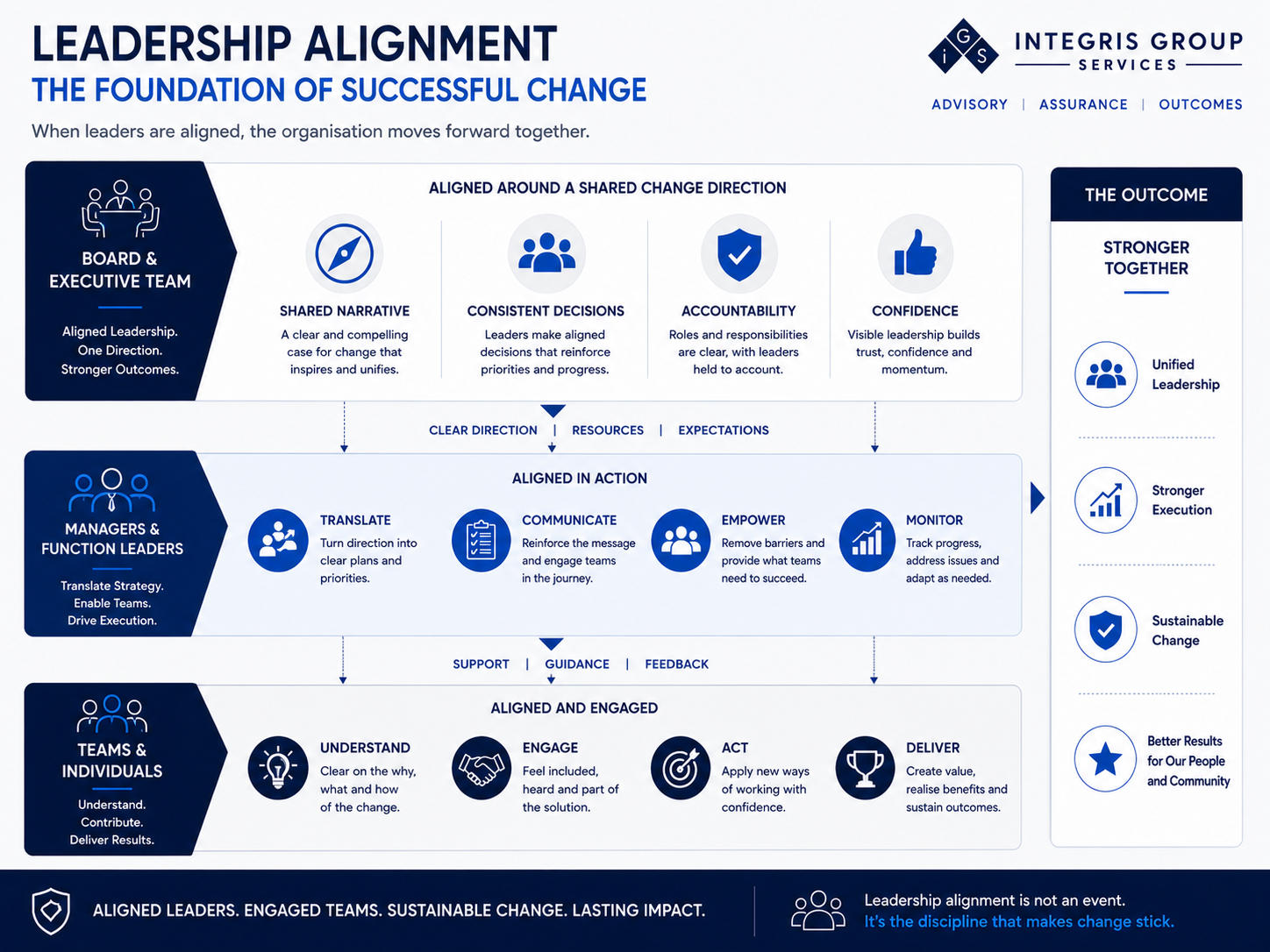
Leadership alignment is one of the most important factors in successful change management. When leaders are aligned, the organisation receives clear, consistent and confident messages about what is changing, why it matters and how success will be achieved. When leaders are not aligned, uncertainty spreads quickly. Employees are highly attuned to inconsistency. If different leaders provide different explanations, prioritise different outcomes or demonstrate different levels of commitment, employees may question whether the change is real, necessary or likely to last. Leadership alignment is not simply agreement in principle. It requires leaders to understand the purpose of the change, the expected benefits, the impact on their teams, the key risks, the decisions required and the behaviours they must model. This is especially important in complex transformations where change affects multiple teams, functions or locations. Leaders need a shared narrative and practical tools to support their teams through transition. Effective leadership alignment is often strengthened through robust governance arrangements that provide clarity around decision-making, accountability and organisational priorities. Strong leadership alignment supports consistent communication, faster decision-making, clearer accountability, stronger employee confidence, reduced resistance, and improved adoption. These outcomes contribute directly to positive workforce experiences and support broader employee engagement and development initiatives. It also helps manage the emotional side of change. Employees often experience uncertainty, frustration or concern during organisational transition. Leaders who are prepared, informed and visible can help create stability while the organisation moves through change. This becomes particularly important when organisations are undertaking significant service transformation, organisational redesign, or strategic reform initiatives. Poor leadership alignment can create the opposite effect. Even well-designed change initiatives can lose momentum when leaders are unclear, passive or inconsistent. In many cases, this can undermine project outcomes regardless of how effectively the technical aspects of delivery have been managed. At Integris Group Services, we view leadership alignment as both a change management and governance issue. Leaders are not simply messengers of change. They are active participants in shaping how change is understood, implemented and sustained. This perspective aligns closely with our broader Management and Operations Consulting approach, which focuses on connecting leadership capability, governance, organisational performance and transformation outcomes. Where complex projects are involved, leadership alignment is also strengthened through effective PMO Consulting practices that ensure governance, reporting, decision-making and stakeholder engagement remain coordinated throughout the change journey. Change succeeds when leaders move together. Alignment creates the confidence employees need to step away from old ways of working and commit to new ones.
Learn More →
Connecting Change Management with Project Delivery
Connecting Change Management with Project Delivery

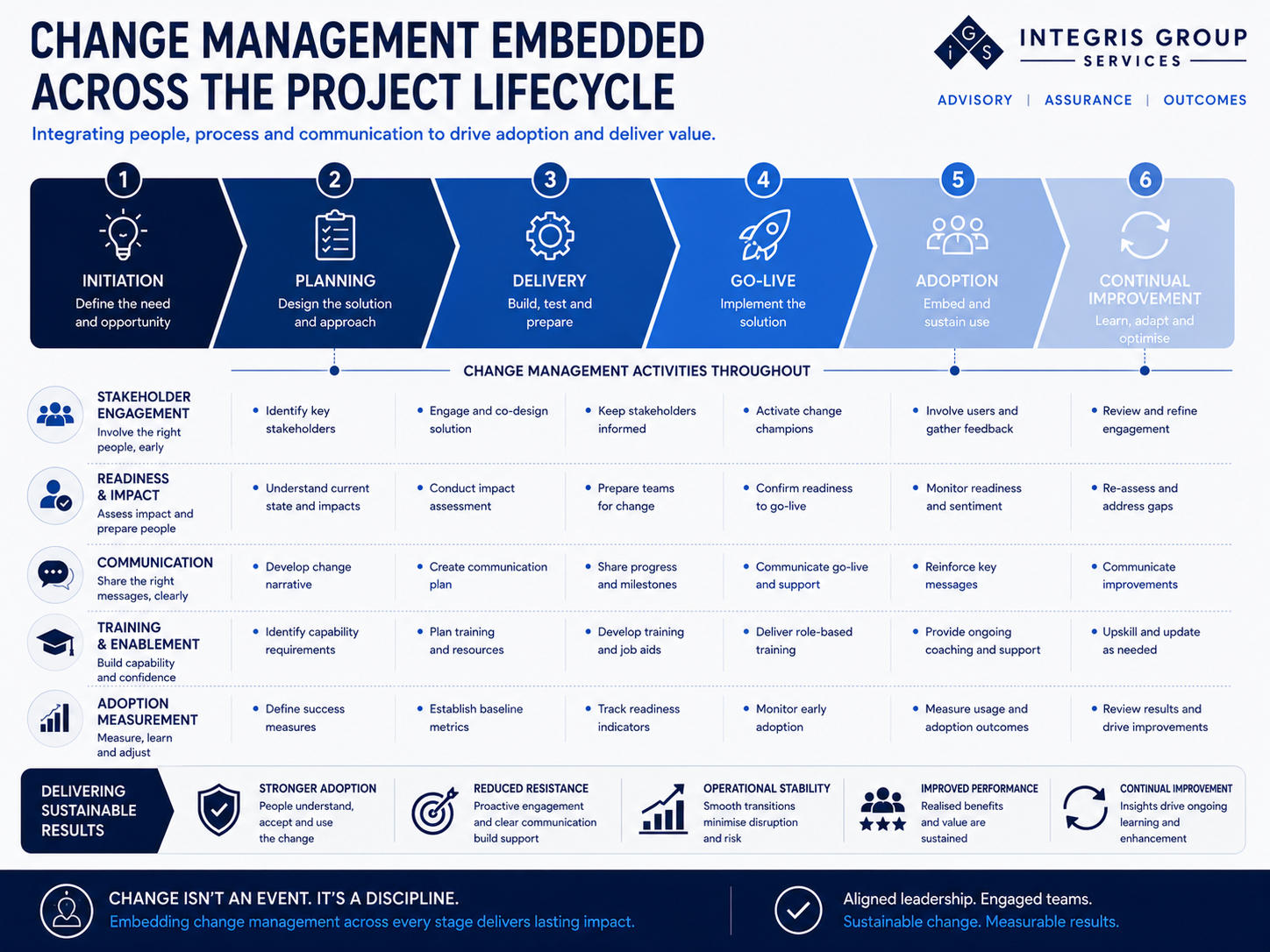
Change management and project delivery are often managed as separate workstreams. Project teams focus on scope, milestones, budget and deliverables, while change teams focus on communication, training and stakeholder engagement. This separation can create problems. Projects deliver outputs, but organisations need outcomes. A new system, process, policy or operating model only creates value when people adopt it and use it effectively. If change management is disconnected from project delivery, organisations may complete the technical work without achieving the intended operational benefit. For this reason, change management should be embedded into the project lifecycle from the beginning. During initiation, change management helps identify affected stakeholders, adoption risks, communication needs and workforce readiness considerations. During planning, it supports training design, engagement strategy, impact assessment and transition planning. During implementation, it helps manage resistance, reinforce expectations and support leaders. After go-live, it helps monitor adoption, resolve issues and embed new behaviours. This integrated approach gives leaders greater visibility over whether the organisation is genuinely ready for change. It also strengthens decision-making by ensuring project governance considers both delivery milestones and organisational readiness. Strong governance arrangements help ensure accountability, oversight and escalation processes remain aligned throughout the change journey. Project reporting should therefore include more than task completion. It should also show change readiness, stakeholder sentiment, training progress, adoption risks and post-implementation support requirements. This broader perspective enables leaders to make informed decisions about implementation timing, workforce preparedness and operational impacts. This is particularly important for technology implementations, service redesign, compliance uplift, organisational restructuring and transformation programs where success depends on both technical delivery and workforce adoption. Through PMO Consulting Services and Service Transformation Consulting, Integris Group Services helps organisations align change management with project governance and delivery disciplines. This integrated approach is often supported by broader Management and Operations Consulting initiatives that connect organisational objectives, transformation priorities, governance requirements and implementation activities. Successful project delivery also depends on workforce engagement and organisational readiness. Change programs that actively involve employees, build capability and address concerns early are more likely to achieve sustainable outcomes and support positive employee engagement and development outcomes. The most successful transformations do not treat change management as an afterthought. They recognise that adoption is part of delivery. A project is not truly complete when the output is delivered. It is complete when the organisation can operate effectively in the new way.
Learn More →
Managing Change Fatigue in Organisations
Managing Change Fatigue in Organisations

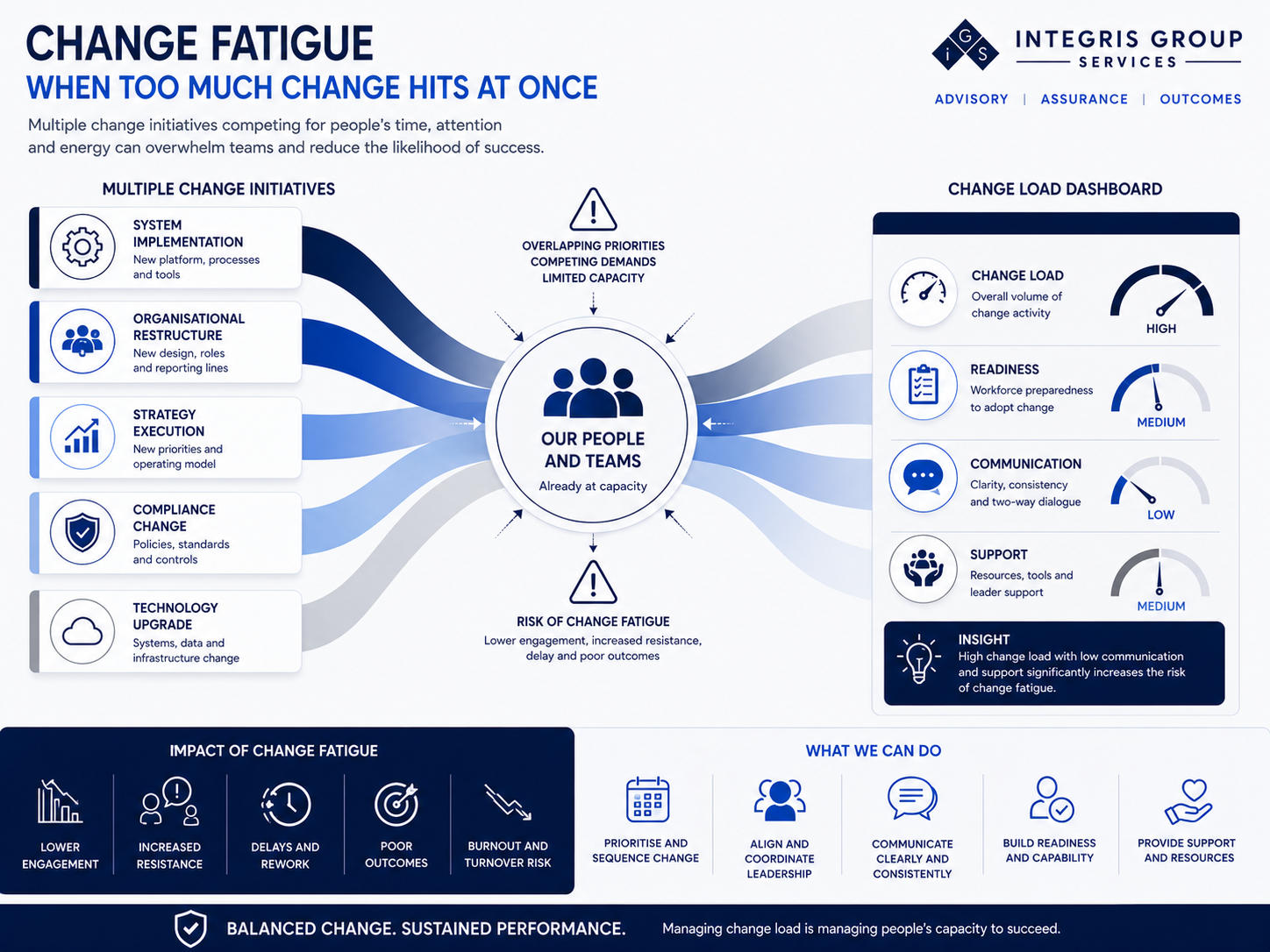
Change fatigue occurs when employees are exposed to repeated or poorly coordinated change without sufficient clarity, support, or recovery time. It is common in organisations experiencing rapid growth, restructuring, technology implementation, compliance uplift, leadership changes, or service transformation. While each individual change may be justified, the cumulative impact can place significant strain on employees and managers. Change fatigue can appear in several ways. Employees may become disengaged, sceptical, or resistant. Managers may struggle to explain competing priorities. Teams may adopt informal workarounds or delay commitment because they expect the next change to replace the current one. When change fatigue is ignored, it can undermine even well-designed initiatives. Managing change fatigue requires visibility. Leaders need to understand not only what changes are planned, but how those changes interact across the organisation. Multiple initiatives may affect the same teams at the same time, creating workload pressure, role ambiguity, or confusion. This is why change management should be connected to governance and portfolio oversight. Organisations need a clear view of the total change load, not just individual projects. Strong governance and effective portfolio coordination help leaders prioritise initiatives, allocate resources appropriately, and reduce unnecessary disruption across the organisation. Practical strategies include sequencing changes more effectively, clarifying priorities, simplifying communication, supporting managers, monitoring workforce sentiment, and ensuring employees understand why changes are being made. Organisations with mature PMO Consulting capabilities are often better positioned to coordinate competing projects and manage the cumulative impacts of organisational change. Change fatigue also connects closely with workforce wellbeing and psychosocial risk. Poorly managed change can contribute to uncertainty, excessive workload, reduced role clarity, and lower levels of confidence. Linking change planning with Employee Engagement Consulting can help organisations better understand how change is being experienced across the workforce and identify areas requiring additional support. For organisations undertaking significant transformation, change fatigue should be considered alongside broader organisational capability, leadership effectiveness, and strategic priorities. This is where Management and Operations Consulting can help leaders assess organisational readiness, coordinate initiatives, and strengthen the systems required to sustain change over time. The goal is not to avoid change. Organisations must continue adapting. The goal is to manage change in a way that people can understand, absorb, and sustain. When leaders actively manage change fatigue, they protect both organisational performance and workforce confidence. By balancing transformation objectives with organisational capacity, they create an environment where change remains achievable, sustainable, and more likely to deliver its intended outcomes.
Learn More →
Workforce Readiness and Adoption Planning
Workforce Readiness and Adoption Planning

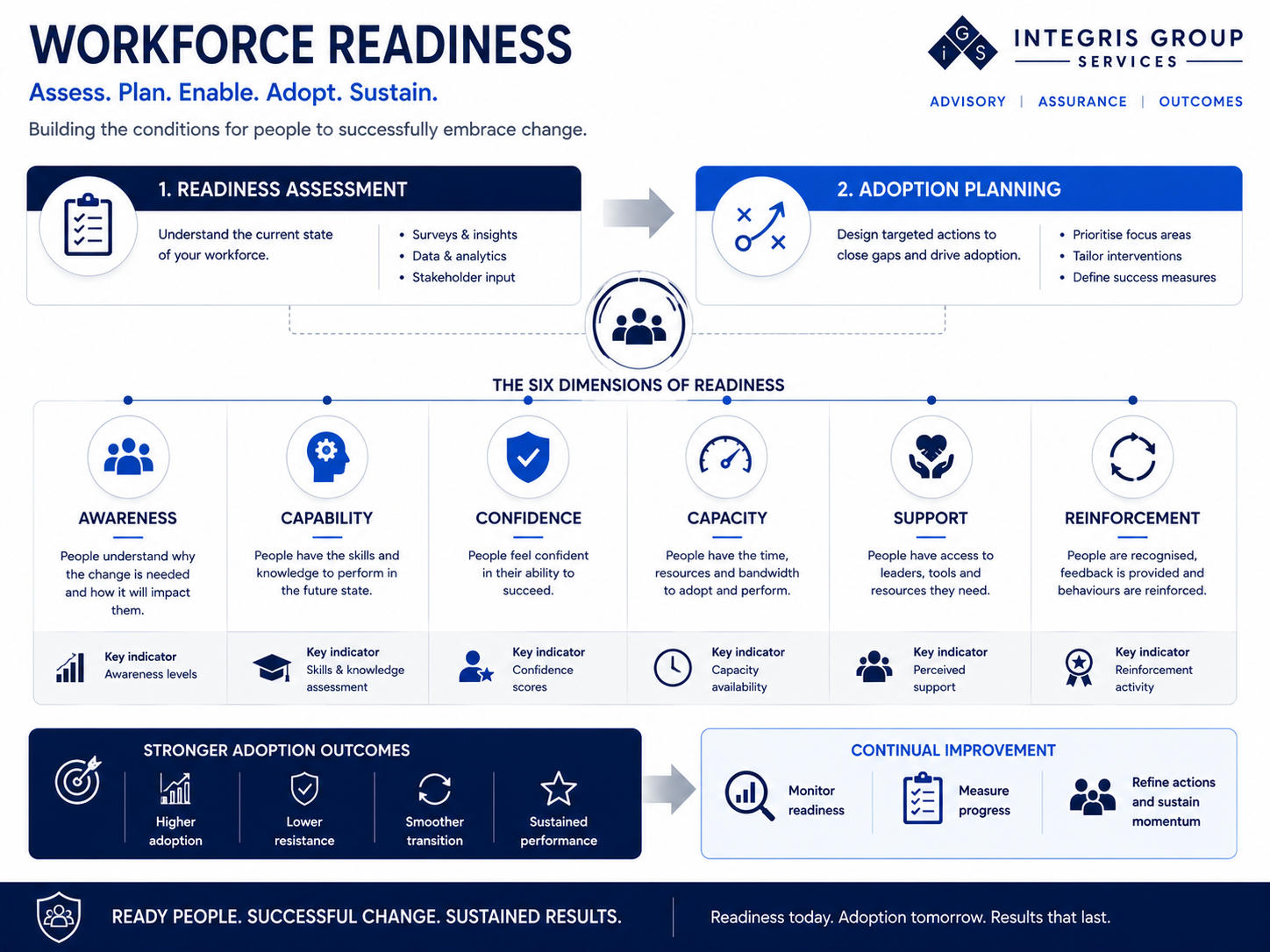
Workforce readiness is one of the clearest indicators of whether a change is likely to succeed. An organisation may have approved the strategy, designed the process and implemented the system, but if employees are not ready to operate in the new way, the change will struggle to deliver value. Readiness is more than awareness. It includes understanding, capability, confidence, capacity and willingness to adopt. A workforce readiness assessment helps leaders understand who is affected by the change, what each group needs to know, what skills or behaviours need to change, where resistance may emerge, what support is required, and whether teams have capacity to absorb the change. This information allows organisations to tailor communication, training and implementation support more effectively. Adoption planning then translates readiness insights into practical action. It defines how the organisation will support people before, during and after implementation. This may include training programs, leader briefings, user guides, process walkthroughs, coaching, feedback channels, change champions and post-go-live support. These activities are often strengthened through broader Employee Engagement and Development initiatives that help build workforce confidence, capability and participation. Without adoption planning, organisations often rely on hope. They assume that because a change has been explained, it will be used. In practice, adoption requires reinforcement. This is especially important for system implementation, compliance changes, new policies, service redesign and operating model changes. Employees need to understand both the technical requirements and the practical implications for their work. At Integris Group Services, we help organisations design workforce readiness and adoption activities that are proportionate, practical and connected to operational outcomes. These activities are often supported by Management and Operations Consulting and PMO Consulting approaches that align people, systems, governance and implementation planning. Successful change requires more than implementation. It requires people to feel equipped, supported and confident enough to work differently.
Learn More →
Change Management for Compliance and Regulatory Uplift
Change Management for Compliance and Regulatory Uplift

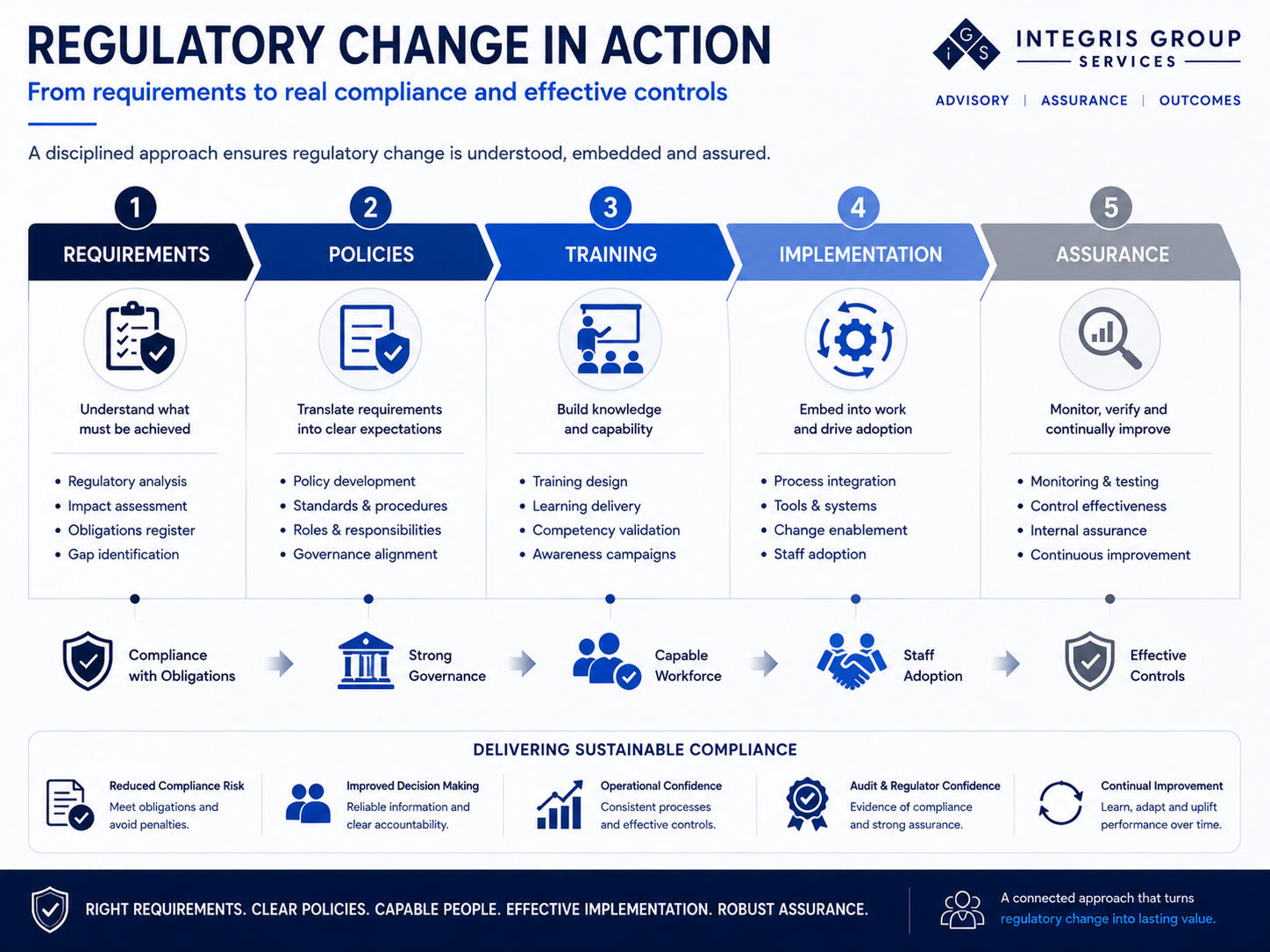
Compliance and regulatory change can be particularly challenging because organisations often treat it as a documentation exercise. A new policy may be approved, a procedure may be updated, or a control framework may be introduced, but the real test is whether employees understand and apply the change in practice. Regulatory uplift requires more than technical compliance. It requires behavioural and operational adoption. This is where change management plays a critical role. When compliance changes are introduced without structured change support, organisations risk creating paper compliance. Documents exist, but day-to-day behaviours remain unchanged. Staff may be unaware of new obligations, managers may apply requirements inconsistently, and leaders may lack visibility over whether the change has been embedded. Effective compliance change management helps organisations translate regulatory requirements into practical operating expectations. This includes identifying affected roles, assessing process impacts, updating policies and procedures, developing training and communication, clarifying accountability, monitoring implementation, and reviewing control effectiveness. Compliance change also benefits from strong governance. Leaders need visibility over implementation progress, adoption risks, assurance findings, and control effectiveness. This ensures regulatory change is not simply launched, but embedded, monitored, and tested over time. Through Compliance Management and governance advisory support, Integris Group Services helps organisations connect regulatory requirements with practical implementation. This often involves aligning compliance initiatives with broader Management and Operations Consulting programs to ensure regulatory obligations support organisational objectives rather than operate as isolated activities. For organisations undertaking broader transformation, regulatory uplift is frequently linked to Service Transformation Consulting initiatives that seek to improve processes, strengthen controls, enhance service delivery, and build organisational capability. Effective project governance through PMO Consulting can also help coordinate implementation activities, manage dependencies, and provide visibility over compliance-related risks and milestones. Successful compliance change relies heavily on workforce understanding and engagement. Employees need to know not only what has changed, but why it matters and how it affects their responsibilities. Supporting workforce capability through communication, training, and broader Employee Engagement and Development initiatives can significantly improve adoption and reduce implementation risk. For regulated organisations, not-for-profits, health, education, defence, government, and professional services, this integrated approach can significantly reduce risk while improving organisational consistency and accountability. Compliance is only effective when it becomes part of how the organisation operates. Change management helps bridge the gap between formal obligation and everyday practice.
Learn More →
Sustaining Change Through Continual Improvement

Sustaining Change Through Continual Improvement

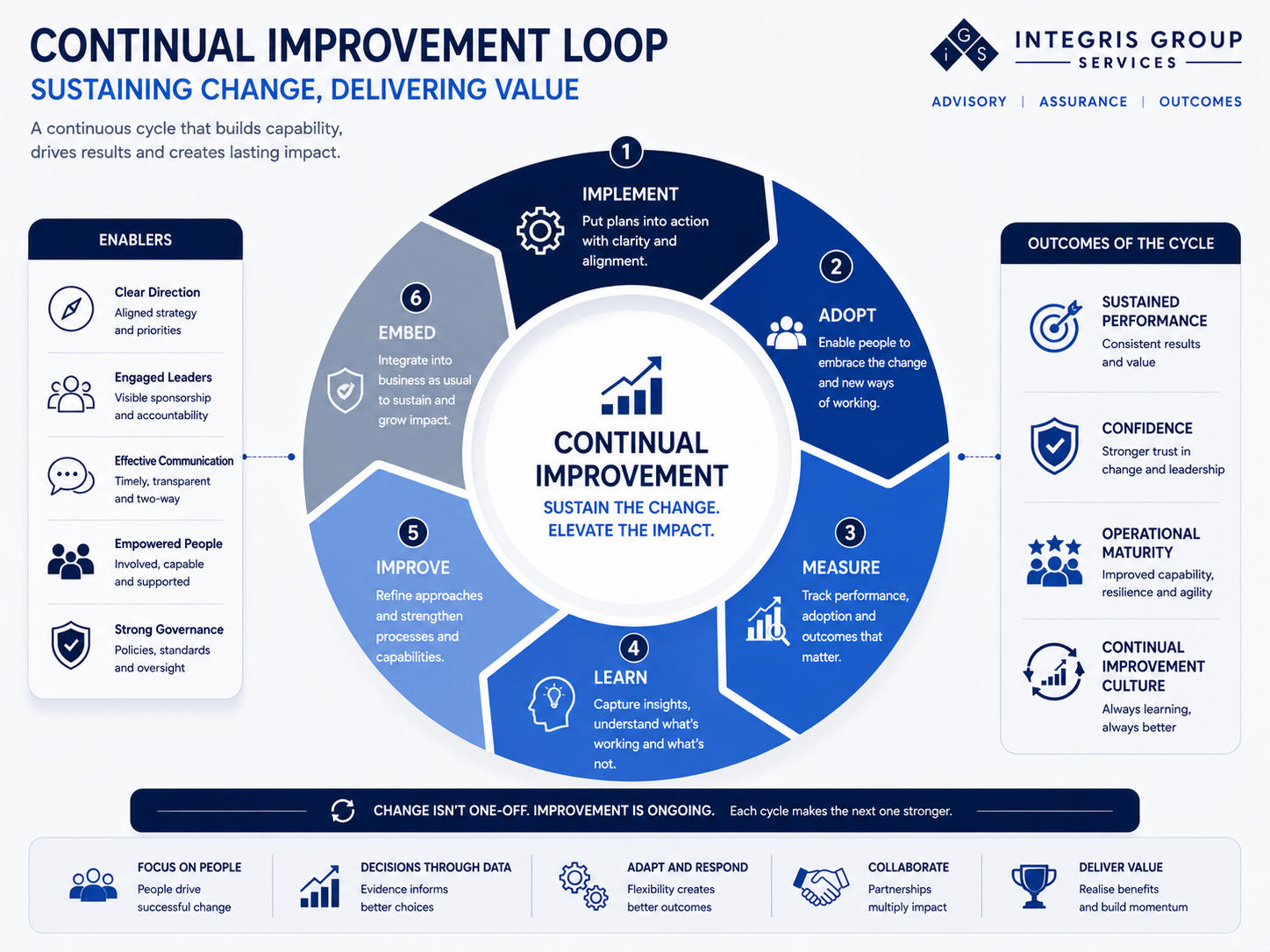
The final stage of change management is often the most overlooked: sustaining the change after implementation. Many organisations invest significant energy into planning, communication, and go-live activities, only to lose momentum once the initial project phase ends. Employees gradually revert to old habits, new processes are inconsistently applied, and benefits are not fully realised. Sustaining change requires ongoing reinforcement. This includes monitoring adoption, gathering feedback, resolving barriers, supporting leaders, measuring performance, and making practical improvements over time. Change should not be viewed as a single event. It is a transition from one operating state to another, and that transition continues after implementation. Continual improvement helps organisations identify whether the change is working as intended. It allows leaders to ask whether people are using the new system or process, whether expected benefits are being realised, whether there are unintended consequences, whether additional support is required, what can be simplified or improved, and what the organisation has learned from the implementation process. This approach is particularly valuable for service transformation, technology implementation, compliance uplift, and organisational redesign initiatives where long-term adoption is essential to achieving sustainable outcomes. Sustained change also requires ownership. If accountability is unclear after implementation, issues may go unresolved and the change may lose priority. Clear governance, reporting, and feedback loops help ensure the new way of working becomes embedded and continues to evolve as organisational needs change. Many organisations strengthen post-implementation outcomes through ongoing PMO Consulting and Management and Operations Consulting support, helping leaders monitor benefits realisation, maintain accountability, and align continual improvement activities with organisational objectives. Workforce engagement also remains critical after implementation. Employees who are encouraged to provide feedback, contribute ideas, and participate in improvement activities are more likely to support and sustain change over time. This aligns closely with broader Employee Engagement and Development initiatives that help organisations strengthen capability, ownership, and organisational performance. At Integris Group Services, we support organisations to embed change through practical systems, capability building, and continual improvement. Our focus is not simply helping organisations implement change, but helping them sustain it. The most successful organisations do not treat change management as a project phase. They treat it as an organisational capability. When change is reinforced, reviewed, and improved, transformation becomes more than an initiative. It becomes part of how the organisation learns, adapts, and performs.
Learn More →

Common Questions

Change management consulting helps organisations plan, implement and embed change effectively by aligning people, processes, systems, governance, communication and leadership support throughout a transformation.

Change initiatives often fail when they are treated as communication exercises rather than operational transformations. Common issues include unclear ownership, weak governance, poor stakeholder engagement, insufficient leadership alignment, limited training, and lack of practical implementation support.

Integris Group Services supports organisations with change strategy, stakeholder engagement, communication planning, governance alignment, training, readiness assessment, project integration, and post-implementation adoption.

We support operating model changes, service transformation, technology implementation, compliance uplift, workforce transition, governance reform, process improvement, organisational redesign and strategic transformation programs.

Change management should be embedded into project delivery so that people, processes and systems are prepared for implementation. Our PMO Consulting Services help organisations connect change activities with milestones, governance, reporting and outcomes.

Leadership alignment creates clarity, consistency and confidence. When leaders communicate different messages or apply change inconsistently, employees can become confused, disengaged or resistant.

Change success can be measured through adoption rates, workforce readiness, stakeholder feedback, performance indicators, operational stability, training completion, process compliance and achievement of intended business outcomes.

Find Us

Let's Build Something Great Together

We'd love to hear from you